



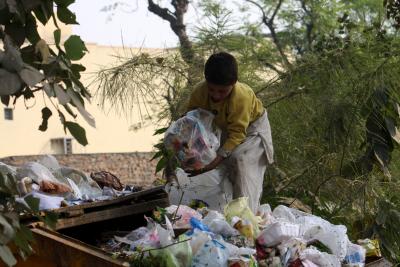
Islamabad, March 11 (IANS) Pakistan’s sanitation workers endure hardship driven by entrenched caste hierarchies, discriminatory hiring, absence of legal protections, institutional neglect, social stigma, gendered exploitation, and economic injustice. Their suffering is deeply embedded in the fabric of the state and society, rendering it largely invisible, a report said on Tuesday.
According to a report in the European Times, with their labour sustaining cities, preventing disease, and upholding public health, sanitation workers across Pakistan deserve dignity, safety, fair wages, and equal rights – not as charity, but as justice.
“Sanitation work in Pakistan exists at the crossroads of caste, class, religion, and gender, forming one of the country’s most entrenched and least acknowledged human rights crises. The people who keep Pakistan’s cities functioning by cleaning streets, unclogging drains, and descending into sewers are treated as expendable. Their labour is indispensable, yet their lives are consistently devalued. For women sanitation workers, the burden is even heavier, shaped by a ‘triple discrimination’ rooted in caste, religion, and gender,” the report detailed.
“Sanitation work is not merely a profession in Pakistan; it is a caste-designated occupation inherited through generations. The majority of workers come from so-called ‘lower-caste’ Christian and Hindu communities, pushed into this work by discriminatory recruitment practices and the absence of real employment alternatives,” it added.
Citing Pakistan’s National Commission for Human Rights (NCHR) findings titled ‘Risk of Sanitation Work in Pakistan’, the report documented “widespread injuries, deaths, and unsafe conditions”, reflecting the lack of a comprehensive national health-and-safety system.
“Without regulatory enforcement or emergency response mechanisms, workers are routinely exposed to hazardous environments and toxic gases. The continued deaths of Christian labourers engaged in manual scavenging constitute a grave violation of fundamental rights and a persistent failure of the state to fulfil its constitutional obligations,” it mentioned.
According to the report, Pakistan’s Supreme Court has questioned if public office has become “mere evasion of duty,” and asked whether sewerage workers’ lives are regarded as less valuable than those of other citizens.
“For women sanitation workers, the crisis deepens. They face the same caste – and religion-based discrimination as their male counterparts, but with the added burden of gendered exploitation. Amnesty International describes their situation as ‘triple discrimination’, capturing the compounded vulnerabilities they endure. Women workers often earn far below the legal minimum wage, and face heightened social stigma, limited mobility, and greater barriers to accessing social protection schemes,” it stated.
Highlighting the discrimination, the report further said, “Economic marginalisation is a defining feature of sanitation work in Pakistan. Even as workers perform some of the most essential and dangerous labour in the country, they are among the lowest paid.”
–IANS
scor/as