




New Delhi, Dec 4 (IANS) With each new legal manoeuvre that strengthens the military establishment’s grip behind the veneer of civilian rule, Pakistan edges closer to an Orwellian security state.
Dissent is increasingly criminalised, surveillance has become routine, and the media landscape now operates as a carefully managed sphere in which the establishment shapes and limits the national narrative.
The latest Freedom on the Net 2025 and Freedom in the World 2025 reports by Washington-based Freedom House capture this steady and alarming contraction of Pakistan’s civic space.
For Pakistan, these reports read less like a routine assessment and more like an indictment of a country which is systematically, deliberately, and now visibly sliding into military-managed authoritarianism. Its abysmal scores signify a political order increasingly shaped not by elected representatives, not by constitutionalism, but by the Asim Munir-led military establishment that has grown more confident, intrusive and unaccountable than at any point in recent decades.
Freedom House’s findings are stark. Pakistan is rated only “partly free” overall, scoring a mere 32 out of 100 on the Global Freedom Index.
On internet freedoms, it fares even worse, designated “not free” with a score of 27. But perhaps the most alarming patterns emerge when we consider these figures not in isolation, but as part of a long downward trajectory.
A decade ago, Pakistan hovered around the low-40s on overall freedom. Though the country was hardly a beacon of democracy then either, it still signalled pockets of pluralism and institutional push-and-pull. But today, the slide has accelerated as the country has descended further down with heightened state control over the sociopolitical lives of people.
The drivers of this decline are neither mysterious nor abstract. Freedom House traces the erosion of rights directly to the expanding hand of Pakistan’s military establishment. Inarguably, this institution has always stood as the country’s most powerful actor. However, under the present Army Chief Field Marshal Asim Munir, it has consolidated power in ways more sweeping and unapologetic than any civilian era in recent memory.
The different indices that chart the distortion of Pakistan’s basic democratic mechanics, such as elections, political competition, judicial independence, press freedom, and the right to dissent, are demonstrated by its abysmal scores of 12/40 in political rights and 20/60 in civil liberties.
In theory, Pakistan continues to hold regular elections under a multiparty system. In practice, as the report notes, the military “exercises enormous influence over government formation and policies, intimidates the media, and enjoys impunity for indiscriminate or extralegal use of force.”
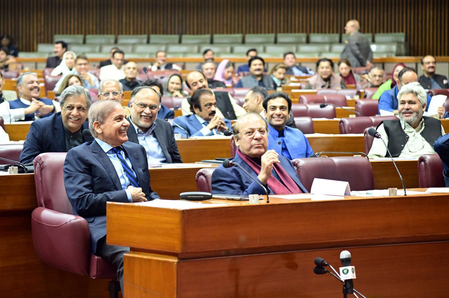
The country’s elected government of Shehbaz Sharif increasingly resemble a civilian façade layered over an entrenched praetorian order.
This is not new, though. Pakistan has experienced repeated military coups and hybrid regimes. But what marks the current moment as especially perilous is how institutionalised the military’s dominance has become.
The series of constitutional amendments pushed through the National Assembly in 2024 (26th Amendment) and 2025 (27th Amendment) has re-engineered the architecture of the state in favour of the generals.
While the 26th Constitutional Amendment of 2024 extended the tenures of the services chiefs from three to five years, the 27th Amendment marks an even more striking shift. It abolished the Joint Chiefs of Staff Committee, which, on paper, was open to senior officers of three services, and replaced it with a new post, the Chief of Defence Forces, to be held concurrently by the Army Chief. This change effectively elevates the Pakistan Army and the Army Chief’s office to unquestioned supremacy.
In any democracy, such structural changes would be subject to debate, judicial challenge, and political scrutiny. But, when it comes to Pakistan, these legislations were enacted with such speed that it reflected both the military’s tightening grip and the political class’s weakened capacity, or to say so, acquiescence.
Freedom House’s scoring on political rights captures a truth Pakistanis have long known: the judiciary, once lauded for moments of assertiveness, has largely capitulated to the military’s dominance. The courts have been transformed into, at best, inconsistent arbiters of constitutionalism, and at worst, instruments for legitimising the establishment’s preferences.
As the report notes, the military has grown “more powerful than any other state institution, including the judiciary and the elected government.” And under Asim Munir, the imbalance has become almost structural through constitutional gerrymandering (26th & 27th amendments), which has altered the very framework of judicial governance and stripped the Supreme Court of discretionary powers while creating a parallel Federal Constitutional Court (FCC).
As such, where the judiciary once served as a potential counterweight, it has been aligned with the military’s political calculus by design.
The decline in civil liberties is most clearly visible in the collapsing space for free speech. Pakistan’s media, long embattled, has drifted into a state of near-complete management with the military in near control of narrative framing in the country. These practices, once episodic, have now become systemic.
Perhaps the most damning part of the Freedom House assessment is the Freedom on the Net report, which ranks Pakistan as “not free.” Pakistan scores 6/25 on obstacles to access, 13/35 on content limits, and 8/40 on violations of user rights. These are not merely technical metrics; they reflect a country undergoing a dramatic digital transformation—but in the opposite direction of modern democracies.
The report observes that the Pakistani government has imposed “more stringent digital censorship measures to maintain the military establishment’s grip on power and its influence over the country’s elections and civilian governments.”
It includes the expansion of legal and technological instruments to police speech, such as sweeping cybercrime laws, arbitrary takedown orders, surveillance systems, and a nationwide website-blocking mechanism that functions as a digital kill-switch for inconvenient narratives. As such, the digital spaces are being systematically constricted.
Nevertheless, to comprehend Pakistan’s accelerating decline in global freedom rankings fully, one must understand the political logic of the Army Chief Asim Munir’s doctrine. Unlike his predecessors, who seized power overtly, such as Ayyub Khan, Ziaul Haq, and Parvez Musharraf, the current Army chief has employed a model of constitutionalised authoritarianism.
Herein, the goal is to hollow out electoral democracy from its core while preserving its shell for international consumption. And his approach relies not on martial law but on the legal engineering of control.
What emerges is not a transitional aberration, but the architecture of a durable authoritarian state. And the tragedy for Pakistan is that its fragmented and self-interested political class has facilitated this transformation by trading institutional autonomy for short-term survival.
As such, these reports highlight that Pakistan is not on the verge of authoritarianism, but an Orwellian state where democracy exists only as performance, while power rests firmly and permanently in military hands.
–IANS
scor/dan