



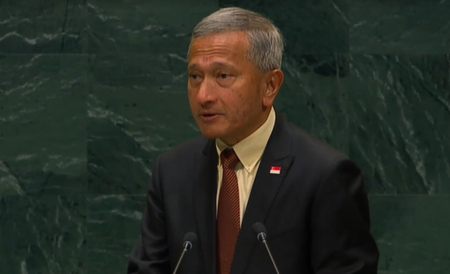
United Nations, Sep 27 (IANS) Singapore’s Foreign Minister Vivian Balakrishnan has called for talks on a United Nations convention on artificial intelligence, warning that governments face serious risks from autonomous systems even as they seek the technology’s economic benefits.
Speaking at an Asia Society discussion, Balakrishnan said the risks fell into three broad areas: loss of control over AI agents, the ability of rogue actors to use the technology for harmful purposes, and damage to public trust and political debate.
“I’m not a doomsdayer, but I think the risks are very high,” he said.
Balakrishnan questioned whether even the people building AI systems could guarantee control over them. “Anyone who tells you, even the creator of the AI, that he’s got absolute control of the kill switch is fooling you,” he said. He added that “loss of control is a very real risk.”
He also warned that AI could make it easier for rogue actors to develop biological or chemical weapons. Another danger, he said, lies in the ease with which convincing images and videos can be made, leaving people less certain of what they see and hear.
The answer, in his view, is to develop safeguards while allowing the technology to advance. He compared AI development to driving a fast car: a powerful engine needs brakes, seat belts and rules of the road.
“I’m not a believer in putting a halt to AI development,” Balakrishnan said. “I’m not even a believer in, you know, just putting the brakes on AI.”
He said the UN offered a forum in which countries of different sizes and technological capabilities could take part. “Do we need a UN convention on AI?” he asked, citing international agreements on the law of the sea and climate change as examples of difficult but necessary negotiations.
Balakrishnan welcomed a discussion on AI between US President Donald Trump and Chinese President Xi Jinping, while acknowledging concerns that the guardrails emerging from their talks were thin. “You need to start somewhere, and I’m glad that that discussion is going on,” he said.
The minister described the United States and China as competitors working from much the same technological foundations. He estimated that America had a lead of perhaps six months in frontier AI models, but said China was determined to seize the opportunities of the new technological era. Their relationship, he said, would have profound consequences for Southeast Asia.
For Singapore and its neighbours, the priority is to gain access to technology, keep supply chains open and put AI to work across their economies. Balakrishnan said Southeast Asia was unlikely to compete with the two powers in developing frontier models, but could excel at deploying AI in public services and other fields.
That would require changes in education and continued training as work evolves. Balakrishnan said Singapore’s focus was on workers whose tasks would change with AI. Whether a particular job disappeared was less certain, he said, but governments had to prepare people for the disruption.
–IANS
lkj/rs