



Seoul, Dec 22 (IANS) The South Korean military has internally updated guidelines in defining the inter-Korean land border when dealing with incursions by North Korean soldiers to prevent the risk of accidental clashes, officials said Monday.
The move comes as North Korean troops have repeatedly violated the Military Demarcation Line (MDL) within the Demilitarized Zone (DMZ) separating the two Koreas since last year in the process of carrying out construction activities near the heavily fortified border.
The Joint Chiefs of Staff (JCS) said it has ordered troops to prioritize markers that indicate the MDL when making decisions, while also “comprehensively” applying both the MDL on the South Korean military map and a line connecting the MDL markers set out by the US-led United Nations Command (UNC), Yonhap News Agency reported.
The move effectively enables the military to use a line drawn farther southward in assessing whether North Korean troops’ border crossings have occurred.
Under the updated guideline, even if North Korean troops cross the line connecting the MDL indicators, the South Korean military may not respond if it assesses it is not the MDL crossing in terms of its own military map.
Nearly 1,300 markers were installed in 1953, a month after the signing of the armistice that ended the 1950-53 Korean War, but only about one-sixth of them are identifiable. Maintenance efforts by the UNC have been suspended since the North fired at workers conducting the job in 1973.
A JCS official said the new guidelines were shared with front-line units in June last year and officially included in an operational guideline in September this year.
The JCS said the decision, which went into effect last year, is aimed at ensuring troops’ firm response and preventing accidental clashes between the two Koreas in the event of a border crossing by North Korean soldiers.
“The measure is limited to situations in which North Korean soldiers conduct activities near the MDL in an exposed environment during daytime,” a ministry official said, stressing that it is not aimed at altering operational procedures or applying the MDL in a way that is favorable to North Korean troops.
But critics said the move could prompt the South Korean military to passively respond to North Korean troops’ border crossing amid Seoul’s efforts to resume dialogue with Pyongyang.
On the inconsistency between coordinates of the MDL used on the South Korean military map and those on the UNC data sets, a JCS official attributed the disparity to different technologies and timings in updating the data sets.
The defence ministry plans to consult with the UNC on addressing the issue next year, as an estimated 60 percent of the coordinates used by the two sides vary, a ministry official said.
Last month, Seoul’s defence ministry proposed holding military talks with Pyongyang on how to clarify the MDL, which marked South Korea’s first official proposal for talks with the North since President Lee Jae Myung took office in June, with a pledge to mend frayed ties with the North and create conditions for dialogue.
The North has yet to respond to the proposal.
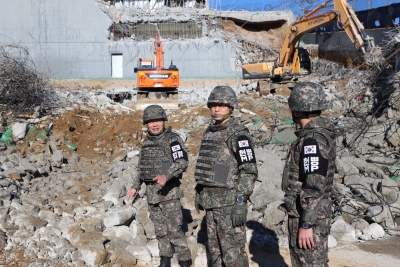
Since April last year, North Korea has deployed troops near the MDL to plant mines, erect anti-tank barriers and reinforce barbed wire fences after the country’s leader Kim Jong-un described inter-Korean ties as those between “two states hostile to each other” in late 2023.
North Korean troops have violated the land border 26 times since last year, with 17 cases reported this year alone, according to the JCS. The most recent case occurred in late November.
Since last year, the South Korean military has aired warning messages about 2,400 times and subsequently fired warning shots 36 times in accordance with guidelines. North Korean soldiers retreated in all cases.
–IANS
akl/as