




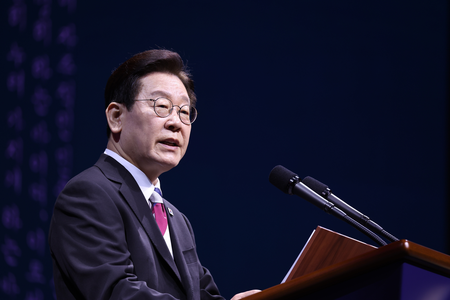
Seoul, March 1 (IANS) South Korea’s President Lee Jae Myung on Sunday urged North Korea to return to the negotiating table with the United States and join efforts to shape what he called a “new future,” vowing to work with relevant countries to turn the Korean War armistice into a peace regime.
Lee made the remarks in his first address marking the March 1 Independence Movement at the COEX exhibition centre in southern Seoul as the nation commemorated the 107th anniversary of the nation’s 1919 independence movement, a watershed event during Japan’s 1910-45 brutal occupation of the Korean Peninsula.
“Since North Korea is formulating and implementing a new five-year plan, I hope that it will swiftly return to the negotiating table and join us in shaping a new future,” Lee said, stressing that “hostility and confrontation serve neither side’s interests.”
North Korea dismissed dialogue with Seoul but appeared to leave the door open for talks with Washington at a key party congress last month, where it unveiled the country’s five-year plans and goals for key sectors, including national defence and foreign affairs, reports Yonhap news agency.
“As a ‘pacemaker,’ we will communicate with the United States and neighbouring countries to ensure that dialogue between North Korea and the United States resumes as soon as possible,” he added.
Lee emphasised that his administration respects the North Korean system and will not pursue any form of unification by absorption nor engage in any hostile acts.
“We will make every effort to convert the armistice system to a peace regime by substantively easing tensions between the two Koreas and working with relevant countries,” he said.
On the alleged civilian drone flights into the North, Lee pledged to take steps to prevent a recurrence, calling it an incident that was entirely unrelated to the intentions of his government and a “grave threat” to peace on the Korean Peninsula.
“There can never be an excuse for actions that provoke tension and clashes on the Korean Peninsula, which is shared by both the South and the North,” he said. “We will thoroughly ascertain the truth about this incident and implement institutional safeguards to ensure that it never recurs.”
Pyongyang has repeatedly demanded that Seoul come up with steps to prevent a recurrence of drone incursions, accusing Seoul of sending drones equipped with surveillance equipment in September and on January 4, prompting the South Korean government to launch an official investigation.
Lee also called on South Korea and Japan to step up bilateral cooperation based on the values of peace and joint prosperity while squarely facing history.
“Our relationship with Japan must also move forward based on the spirit of the March First Independence Movement, which was driven by the pursuit of peace and coprosperity, Lee said. “Through pragmatic diplomacy, the government of popular sovereignty will do everything possible to squarely face the past, jointly address present challenges and move forward into the future.”
Lee has pledged to pursue a “two-track” approach to diplomacy with Japan by expanding future-oriented cooperation while continuing to address unresolved wartime history issues stemming from Japan’s colonial rule of Korea.
He further stressed the importance of deepening trilateral cooperation among Korea, China and Japan, saying harmony in Northeast Asia is “more crucial than ever.”
“Reflecting on the significance of peace and harmony in Northeast Asia, I emphasised the need for Korea, China and Japan to find common ground, communicate and cooperate during my back-to-back visits to China and Japan at the start of this year,” he said.
Lee vowed efforts to “unceasingly continue striving for harmony and prosperity” following the “wishes of our forebears, who sought to use peace in Northeast Asia to achieve world peace.”
In January, Lee visited China and Japan and met with Chinese leader Xi Jinping and Japanese Prime Minister Sanae Takaichi to discuss cooperation and pending issues as part of his shuttle diplomacy efforts.
In his speech, Lee also highlighted the need for the global community to reflect on the spirit of South Korea’s independence movement in this age of crisis, when “democracy and peace are once again under threat.
“I dare say that I am confident that the spirit of the March First Revolution, championed by our forebears and steadfastly upheld by our people, will serve as a beacon for the global community as it endures an era of crisis in which democracy and peace are disrupted, guiding it toward a new world of hope,” Lee said.
–IANS
sd/