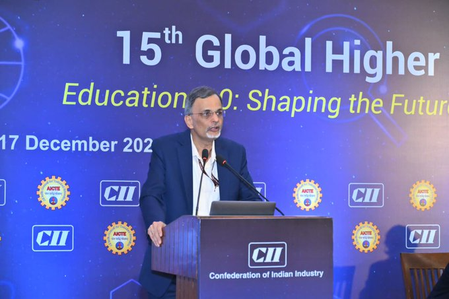
New Delhi, Dec 17 (IANS) The next phase of higher education reform in India must be led by states, said Dr Anantha Nageswaran, Chief Economic Adviser to the government, on Wednesday.
Speaking at the CII Global Higher Education Summit in New Delhi, Nageswaran outlined key priorities for states, including a shift from control to stewardship, and the need to urgently address faculty shortages through mechanisms such as professors of practice.
He noted that moving from input-based to outcome-based regulation, adopting an entrepreneurial approach in public administration, and financing institutions based on differentiated roles and outcomes can help scale the reforms.
Nageswaran also called for deeper industry engagement in curriculum design, research, and governance.
“Industry can co-design curricula, offer credit-bearing internships, support applied research, share infrastructure, and participate meaningfully in governance,” he said.
“Collaboration between government, states, industry, and citizens can help India move from scale to leadership and emerge as a global hub for learning, research, and ideas,” the CEA added.
Nageswaran shared that India’s demographic and economic inflection point, structural shift in global higher education landscape, AI-enabled pedagogy, and the change in policy with National Education Policy (NEP) 2020 and evolving regulatory thinking, are the four converging factors that show that the present time is uniquely suited for ambitious reform.
At the event, Prof Anil Sahasrabudhe, Chairman, National Education Technology Forum, highlighted how recent reforms in higher education are creating a future-ready, student-centric ecosystem anchored in quality, flexibility, and innovation.
He noted that the proposed new regulatory framework will bring all higher education regulators under a single umbrella with a single-window approval system, enabling institutions to offer multidisciplinary programs with greater ease.
Dr Naushad Forbes, Past President, CII & Chairman, highlighted that the deepest source of long-term resilience for any economy or institution lies in the quality of its human capital, which is built through a combination of education and accumulated skills.
Economic transformation depends not only on the creation of knowledge but on the ability of skilled individuals to translate ideas into practical outcomes.
Emphasising the central role of higher education in innovation, he called for a substantial increase in public research funding within universities.
The expert argued that universities must primarily be seen as creators of talent and advocated a shift from prescriptive regulation towards greater autonomy and competition.
–IANS
rvt/