




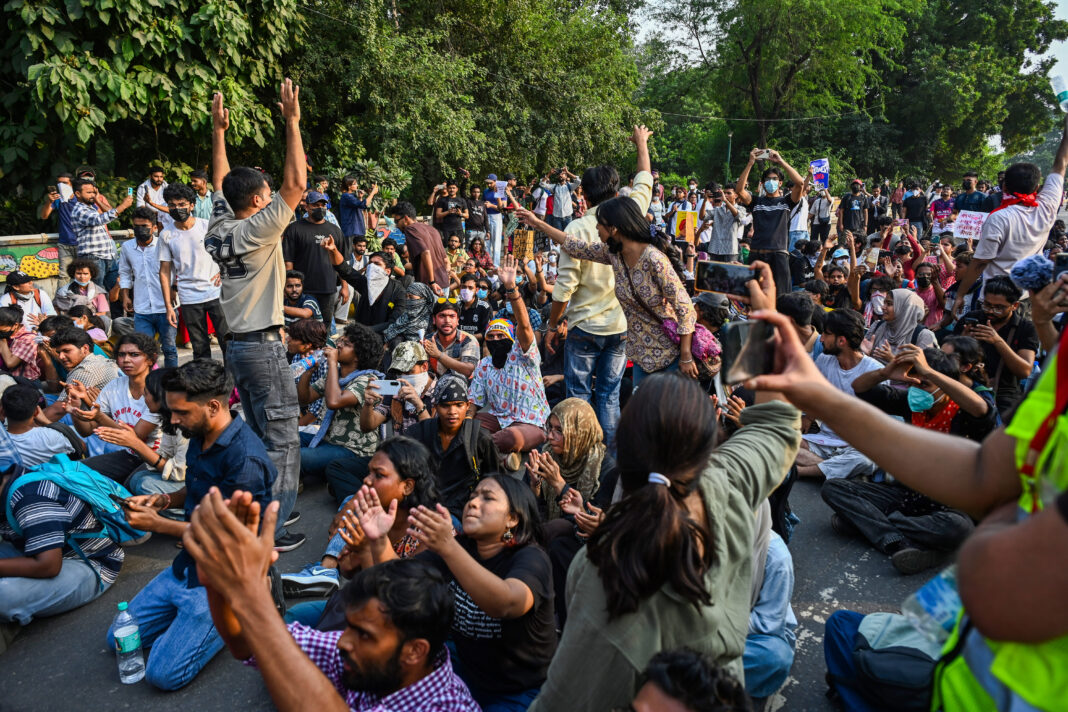
The Cockroach Janta Party’s escalating agitation demanding the resignation of Chief Election Commissioner Gyanesh Kumar raises a fundamental question for Indian democracy: should grievances against constitutional authorities be settled on the streets or in the courtroom? The CJP’s persistence — thousands at Mumbai’s Shivaji Park despite police denial of permission, over 700 detained in Delhi, and vows to continue until the CEC resigns — reflects genuine public anxiety over the Special Intensive Revision of electoral rolls. Yet the manner in which this agitation is being pursued threatens to establish a precedent that undermines the very constitutional order the protesters claim to defend.
The substantive concerns are not frivolous. The Election Commission’s SIR has removed over 130 million names from voter lists, with opposition parties alleging disproportionate impact on Muslim voters and other minorities. Two Election Commissioners reportedly raised objections at least 14 times over ten months regarding decisions taken without their knowledge. These are serious allegations that merit rigorous scrutiny.
However, a crucial fact must be stated plainly: Gyanesh Kumar has not resigned. In late September 2026, a letter addressed to President Droupadi Murmu and purportedly signed by Kumar, announcing his resignation as CEC, went viral on social media. The Election Commission officially declared the document “fake”. An EC spokesperson described the purported letter as “fake,” effectively dismissing claims that Kumar had submitted his resignation. Yet the CJP has continued its agitation undeterred, vowing to protest at Jantar Mantar “until Gyanesh Kumar resigns” — a demand premised on a resignation that never happened.
This is precisely why street agitation cannot substitute for due process. The Constitution provides a clear framework for addressing grievances against the CEC. Under Article 324(5), the CEC can only be removed through a parliamentary impeachment process mirroring that for a Supreme Court judge, requiring a motion supported by a two-thirds majority in both Houses. The opposition has already moved in this direction — a notice of motion for Kumar’s removal was submitted to the presiding officers. Simultaneously, petitions challenging the 2023 appointments law and the CEC’s appointment itself are pending before the Supreme Court.
On October 5, 2026, the Supreme Court declined to pass an interim order suspending Kumar, though it issued notices to the Centre, the CEC, and other election commissioners over allegations of unilateral decision-making. The bench, headed by Chief Justice Surya Kant, said it would first seek responses and examine whether any statutory provisions were violated, observing that it cannot pass an ex-parte order solely on the basis of newspaper reports. The Court also made clear that any modifications to Form 6 were not made by it, shifting scrutiny onto the Election Commission.
These judicial proceedings demonstrate that the constitutional machinery is functioning. The correct response to a flawed process is not to abandon process altogether, but to insist that it be followed — rigorously, transparently, and with evidence rather than slogans as its currency. If street pressure succeeds in forcing a CEC’s resignation without constitutional process, it establishes that any sufficiently mobilised group can override institutional safeguards — a precedent equally available to future governments with less benign intentions. Democracy is tested not when institutions enjoy public confidence, but when citizens challenge them.