




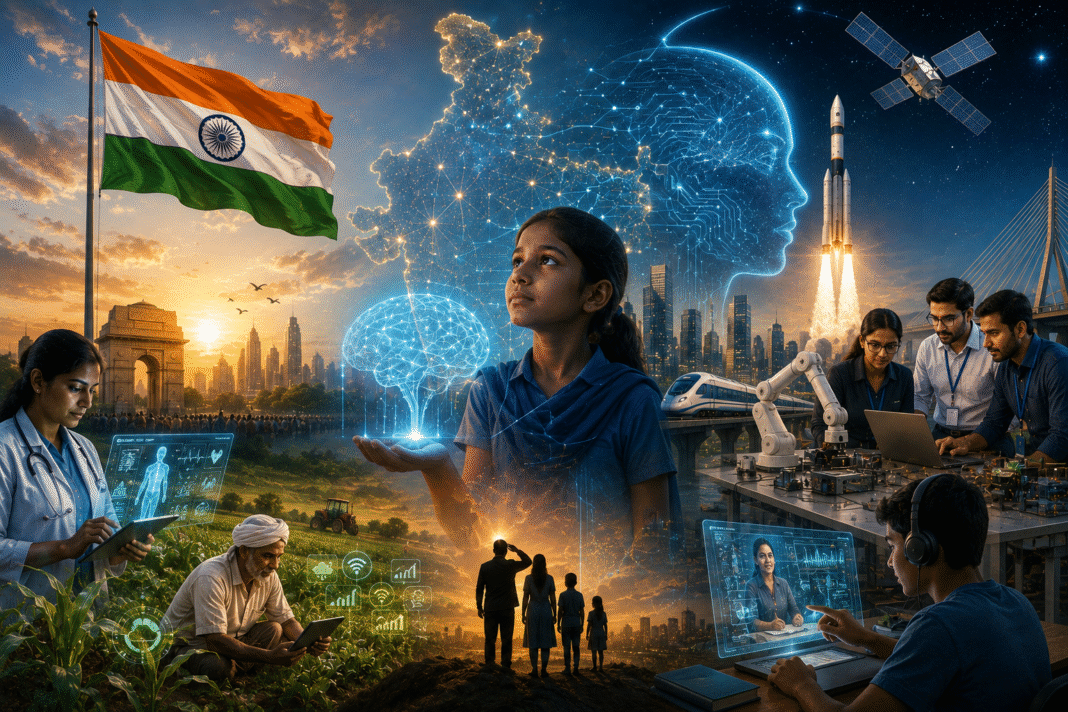
As the tricolour unfurls on another Independence Day, India stands at a crossroads not merely of history but of cognition. The world is entering an age where intelligence is no longer exclusively human. Artificial Intelligence—an amalgam of algorithms, data, and computing power—is reshaping economies, democracies, and the very definition of labour. For a nation that secured political freedom in 1947, the next great struggle will be technological: the race to harness AI to leapfrog generations of poverty, or the failure to do so that risks confining millions to a new digital serfdom.
The opportunity is immense. India possesses the raw material of the AI age in abundance: a demographic powerhouse with a median age under thirty, an English-speaking technical workforce, and a digital public infrastructure—most notably UPI and the Account Aggregator framework—that is the envy of the world. In healthcare, AI models trained on diverse Indian genetic data can diagnose ailments in rural hinterlands where a doctor has never set foot. In agriculture, predictive weather algorithms and computer vision can save small farmers from the twin cruelties of climate change and market volatility. In education, a personalised AI tutor, whispering in a child’s mother tongue, could democratise elite instruction and finally break the back of the coaching-class industrial complex. India’s opportunity is not merely to consume AI but to build “Indic AI”—models trained on the country’s linguistic diversity and cultural contexts, owned by its institutions, and aligned with its civilisational values.
Yet this gleaming future is threatened by profound challenges. The first is the spectre of mass job displacement. India’s IT services sector, the crown jewel of its post-liberalisation economy, faces an existential restructuring as routine coding and business process management are automated. The nation does not have the luxury of a wealthy, ageing West; it must employ a million young people every month. Without a radical reimagination of skilling—moving from rote coding to AI orchestration and problem-framing—a demographic disaster looms.
The second challenge lies in the digital divide. AI is a voracious consumer of data, yet for hundreds of millions of Indians, lives remain invisible to the digital state. If AI tools are designed only for the English-speaking, data-rich elite, societal inequities will be baked in at an exponential scale. The farmer in Vidarbha and the weaver in Varanasi must not be mere data points to be extracted; they must be active participants who own and benefit from their digital identities.
Finally, there is the challenge of democratic integrity. A society grappling with communal tensions is uniquely vulnerable to the dark arts of generative AI—deepfakes that can spark riots, synthetic propaganda that drowns out truth. India’s crowded, emotive public sphere is fertile ground for algorithmic manipulation. The regulatory frameworks remain embryonic, and the temptation to use AI as a tool for surveillance rather than empowerment is a severe test of constitutional morality.
For the Indian diaspora, the role is pivotal. Sitting at the frontier of global AI research and capital, this community must be more than a source of remittances; it must serve as a bridge of ethics, talent, and critical technology transfer. On this Independence Day, the resolution must be that India becomes not just a back-office of the AI revolution, but its moral and intellectual epicentre. The past was about political self-rule; the future is about cognitive sovereignty. The machine is learning; so must the Republic.