



Agartala, Sep 18 (IANS) After natural rubber, bamboo and other major forestry crops, Tripura is emerging as a potential hub for agarwood cultivation and processing, with the sector expected to boost the state’s economy and generate employment, officials said here on Friday.
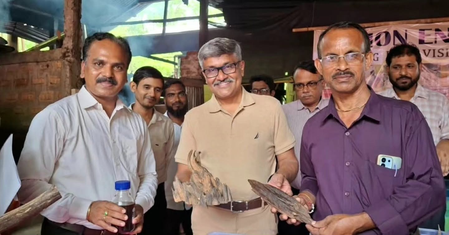
An official of the state’s Industry and Commerce Department said that Union Ministry of Development of North Eastern Region (DoNER) Secretary Srinivas Katikithala visited the Uttar Fulbari agarwood village, plantation and processing unit in North Tripura district on Thursday.
Katikithala urged agarwood growers and workers engaged in the processing unit to make greater efforts to expand agarwood cultivation and processing for their individual prosperity as well as the state’s economic growth.
DoNER Ministry Joint Secretary Angshuman Dey, along with other senior officials, including North Tripura District Magistrate Chandni Chandran and agarwood growers, accompanied the Ministry Secretary during the visit.
An official document said that North Tripura district, which shares inter-state borders with Assam and Mizoram, plays a pivotal role in India’s agarwood industry, with a high concentration of agar trees and accounting for a significant portion of the country’s agarwood production. North Tripura contributes an estimated 90 per cent to 95 per cent of the agarwood industry in Tripura, making it the largest producer of agarwood in the state, the document said.
Kadamtala block is a significant producer, while North Tripura district is particularly well suited for agarwood cultivation due to its soil and climatic conditions. North Tripura has approximately 1.13 crore (11.3 million) agar trees, the highest concentration in the state, while around 15,000 families across the district are engaged in agarwood cultivation and processing, the official document said.
The low input required for management and growth, lack of site specificity, and adaptability to intercropping could make agar a preferred cash crop for farmers.
In Tripura, the critically endangered agar tree is highly adaptable to local conditions. To promote agarwood cultivation, sustainable harvesting and agarwood-based industries, the state government has already formulated an agarwood policy for promoting the tree and its processing in the state.
The policy envisages the sustainable utilisation of agarwood by emphasising all aspects of cultivation, harvesting, processing, transit and trade. The policy also seeks to encourage the planting of agarwood trees to provide farmers with a better source of income and promote agarwood-based industries by ensuring ease of doing business and providing proper market linkages.
Meanwhile, DoNER Minister Jyotiraditya Scindia earlier this year laid the foundation stone for an Rs 80-crore Agarwood Cluster Processing Centre at Uttar Fulbari village in North Tripura district. He had said that the initiative aims to advance Prime Minister Narendra Modi’s vision of promoting local industries on a global scale and directly supports the ‘Vocal for Local’ and ‘One District One Product’ (ODOP) policies.
The Minister had highlighted that nearly 90 per cent of India’s estimated 150 million agarwood trees are found in the Northeast, particularly in Tripura. The initiative is expected to boost Tripura’s agarwood production capacity by 50 per cent and potentially generate an annual sector turnover of Rs 2,000 crore, with direct access to global markets within the next three to four years.
Currently, natural rubber is cultivated on 97,171.93 hectares of land in Tripura. The state is the second-largest natural rubber-producing state in the country after Kerala, producing 1,02,989 tonnes of rubber annually, with an estimated value of Rs 1,620 crore.
According to Forest officials, nearly 44 per cent of Tripura’s geographical area is under bamboo coverage, and the state government is exploring avenues for high-value addition of bamboo, including its use in renewable energy and bio-ethanol production.
–IANS
sc/skp