



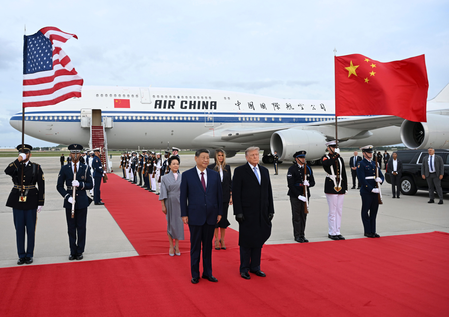
Washington, Sep 24 (IANS) A last-minute extension of the US-China trade truce has eased one immediate pressure on the White House meeting between President Donald Trump and Chinese President Xi Jinping. Taiwan, Artificial Intelligence (AI) and Iran remain on the agenda.
It is Xi’s second visit to Washington as China’s leader. His first was a State Visit in 2015 during Barack Obama’s presidency.
Xi struck a conciliatory note after arriving in the United States. “The two countries should be partners, not adversaries,” he said in a statement.
“The two sides should move towards each other and work together to build a stable relationship — one where co-operation is the mainstay, competition is kept within proper limits, differences are managed and peace can be expected,” he said.
Trade will be a test. During an escalation in 2025, the US imposed tariffs as high as 145 per cent. China responded with levies of up to 125 per cent. Negotiations later brought those rates down.
At their meeting in Busan, South Korea, last October, Trump and Xi agreed to a truce that further reduced a US tariff linked to fentanyl and postponed new restrictions by both countries for a year. That agreement was due to expire on November 10.
After an unscheduled meeting with Chinese Vice Premier He Lifeng on Wednesday night, US Treasury Secretary Scott Bessent announced a two-month extension, until January 10. The move gives negotiators more time but leaves the wider trade dispute unresolved.
Artificial Intelligence is expected to play a larger part in the talks than it did when the leaders met in Beijing in May. China wants Washington to stop expanding controls on advanced chips, computing capacity and AI models. Beijing argues that the restrictions now cover entire sectors, rather than a small number of critical technologies.
The two sides have also taken a step towards dialogue. Vice Premier He and Treasury Secretary Bessent agreed over the weekend to formalise talks on AI, consider a channel for communicating about serious incidents and meet again in November in Shenzhen, on the sidelines of the APEC summit.
Taiwan remains the most sensitive issue. In an editorial, the Communist Party newspaper People’s Daily warned that mishandling it could bring the two countries towards “collision and even conflict.” It described Taiwanese independence movements as a “common enemy”.
China has pressed the United States to stop arms sales to Taiwan. The Trump administration paused a proposed sale after the May summit in Beijing, according to the source notes. Trump has described arms sales to Taiwan as a “very good negotiating chip” with China.
The war involving Iran is another possible subject. Washington hopes Beijing, a major buyer of Iranian oil, will use its economic influence to press Tehran. A US naval blockade has disrupted Iranian shipments through the Strait of Hormuz to China, according to the source notes. Xi has called for a permanent ceasefire, renewed talks on Iran’s nuclear programme and the reopening of the strait.
Trump may also seek the release of Min Zin and Chen Youlin, US citizens designated as wrongfully detained by the State Department.
The leaders have met seven times face to face before this visit. Five meetings took place during Trump’s first term, including visits to Mar-a-Lago and Beijing and encounters at summits in Hamburg, Buenos Aires and Osaka. They met again in Busan last October and in Beijing this May.
–IANS
lkj/ksk/as