



Washington, Oct 21 (IANS) US President Donald Trump announced plans to reward people, including journalists, with one per cent of government funds recovered through fraud investigations, as his administration unveiled a broader crackdown involving tougher criminal penalties and the withholding of $1.2 billion in Medicaid payments to California.
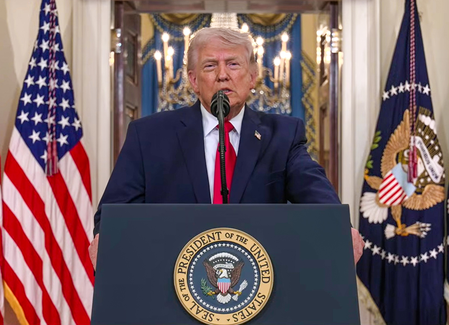
Speaking in the Oval Office alongside Vice President JD Vance and senior administration officials, Trump said the initiative would encourage Americans to expose suspected corruption and the misuse of taxpayer money.
The President said whistleblowers could receive substantial payments for identifying fraud, potentially running into millions of dollars in cases involving large recoveries.
“If you turn somebody in and you, let’s say, report and you find $1 billion, we are giving a commission to that person of 1 percent,” Trump said.
He said the proposed incentive would also be available to journalists, subject to applicable laws and approval from their news organisations.
“Very few things are more important than good journalism,” Trump said, adding that reporters often possessed information that could help uncover wrongdoing.
The President said people could report suspected fraud through a new government website, fraud.gov.
Trump’s announcement went beyond the Justice Department’s separately announced Fraud Whistleblower Incentive Program, which offers payments ranging from $10,000 to $30,000 for qualifying information leading to criminal fraud charges.
During the Oval Office interaction, Vance indicated that the administration envisaged a broader reward system linked to recovered money rather than limiting incentives to criminal prosecutions.
“Our plan is not to limit this just to criminal prosecutions,” Vance said.
“It’s as the president said, if you find the money and you help us recover it, then you benefit from the program.”
The administration did not provide a complete written framework establishing how the proposed uncapped one per cent payments would operate alongside existing federal whistleblower laws.
Trump also said he would personally resolve disputes over who deserved payments.
“I will be the arbitrator of all of these decisions,” he said.
The President said he would make determinations quickly and fairly, potentially dividing awards among competing claimants.
Vance, who heads the White House Task Force to Eliminate Fraud, said the initiative emerged from discussions with Trump about involving ordinary Americans in detecting financial wrongdoing.
He argued that fraud investigations frequently required coordination among several federal departments and agencies.
“Sometimes the fraud will touch seven different departments simultaneously, and you actually need presidential led directive in order to fight that fraud simultaneously,” Vance said.
Trump claimed that his administration had already uncovered $260 billion in fraud.
He also cited investigations involving federal healthcare programmes, food assistance, Social Security and small-business loans.
Senior administration officials called for additional legislation imposing mandatory minimum prison sentences for benefits fraud and civil liability on state officials who knowingly failed to prevent fraudulent activities.
Those measures remain proposals requiring congressional action.
In a separate announcement during the event, Centers for Medicare and Medicaid Services Administrator Mehmet Oz said the federal government was deferring an additional $1.2 billion in Medicaid payments to California.
Oz said the decision concerned personal-care services, whose costs had increased substantially in the state.
“We are going to defer $1.2 billion more from California today,” he said.
He claimed spending on the programme had grown by 24 per cent over three years, approximately twice the average rate elsewhere.
Oz said federal officials wanted California to justify the payments before the money was released.
The announcement represented a funding deferral, not a final finding that the entire amount involved fraud.
Oz also said the administration had deferred approximately $500 million in Minnesota healthcare payments while examining suspected irregularities involving providers.
The administration accused Democratic-led states of failing to prevent misuse of public funds. Those political allegations were not accompanied by findings establishing wrongdoing by the state leaders named during the event.
The announcement followed the Justice Department’s October 20 launch of a whistleblower incentive programme administered by its National Fraud Enforcement Division. The department said the initiative would provide earlier payments to qualifying informants whose information resulted in criminal charges.
Federal whistleblower programmes have traditionally operated under different statutory and administrative arrangements, including the False Claims Act. The administration’s proposed one per cent recovery-based incentive would require clearer implementation rules before its scope, eligibility and relationship with existing programmes could be established.
–IANS
lkj/rs