


Washington, Sep 25 (IANS) Donald Trump and Xi Jinping used military honours, conciliatory language and a lavish White House dinner to steady the world’s most consequential bilateral relationship. But their day in Washington produced a framework for managing rivalry, not a settlement of it.
The visit’s central achievement was political choreography.
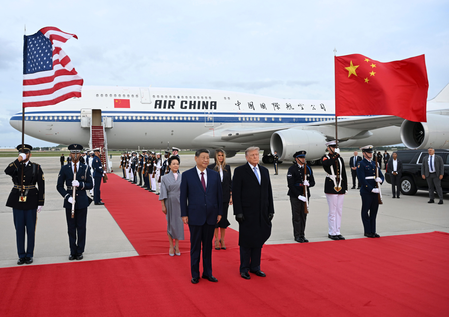
Trump personally received Xi at Joint Base Andrews, an unusual courtesy for a visiting head of state. A red carpet, US service members and a flyover by two B-1 bombers gave the arrival both grandeur and an unmistakable display of American power.
The next morning brought another formal welcome at the White House. Trump called their relationship a “truly great friendship” built on “mutual respect and the vital interests of our people”.
He said their talks would cover security, technology and “superintelligence”.
Xi answered with the language of guardrails. He called for candid dialogue, greater government-to-government contact and regular military communication.
“China and the United States must hold the line of no conflict and no confrontation between us,” Xi said.
That sentence captured the summit better than its ceremonial excess.
Neither leader suggested that the competition over advanced computer chips, artificial intelligence, military power or influence in Asia had disappeared. Xi said competition should be “healthy” and “kept within bounds”. Trump stressed their common interests.
Trade supplied the clearest immediate result.
Treasury Secretary Scott Bessent said a tariff truce, due to expire in November, had been extended until January 10. The arrangement keeps some US tariffs suspended while China maintains supplies of rare-earth minerals needed by American manufacturers.
It buys time. It is not the larger economic bargain both governments say they want.
The Wall Street Journal reported before the meeting that semiconductor export controls, one of Washington’s strongest sources of leverage, were not on the agenda. Agriculture and lower-technology trade offered easier ground.
Artificial intelligence exposed the same pattern.
Xi said the two countries had “the capability and responsibility to develop and manage AI for good” and ensure its development remained under human control. US officials have discussed an incident-notification channel, effectively an AI hotline.
No binding AI agreement or verification system was announced.
The gap between tone and substance was also visible on Taiwan, Iran and human rights. These are issues on which the two governments’ interests sharply diverge. Yet the public remarks offered no new formula on Taiwan, no clear Chinese commitment on Iran and no announced progress on detained Americans or political prisoners.
For Trump, the summit showcased his preference for leader-to-leader diplomacy. For Xi, the full honours demonstrated that Washington received China as an equal despite deep distrust.
The Washington Post described the airport reception as a rare gesture. The New York Times reported criticism that Trump was giving Xi unusually deferential treatment.
As the presidents met, Melania Trump and Peng Liyuan visited the Smithsonian’s National Museum of Asian Art, extending the day’s carefully planned cultural diplomacy.
The state dinner completed the message. American technology executives filled the room. Trump presented Xi with a bald-eagle sculpture and toasted “a future of harmony, peace, and success”.
Xi said their talks had produced “common understanding on many issues”, but did not identify a major new agreement. He argued that China’s national rejuvenation and Trump’s effort to make America great again “can surely be mutually reinforcing”.
Trump and Xi restored ceremony, high-level contact and a vocabulary for coexistence. The rivalry remains. What changed was their joint effort to keep it from becoming uncontrollable.
India has a direct stake in that effort. New Delhi’s border dispute with Beijing, participation in the Quad and dependence on global technology, energy and mineral supply chains make the course of US-China relations important for its security and economy.
Trump and Xi had met seven times before the Washington summit, including encounters in Florida, Germany, Argentina, Japan, South Korea and Beijing. Xi’s latest trip was his second formal state visit to the United States and his first visit to Washington in more than a decade.
–IANS
lkj/rs