



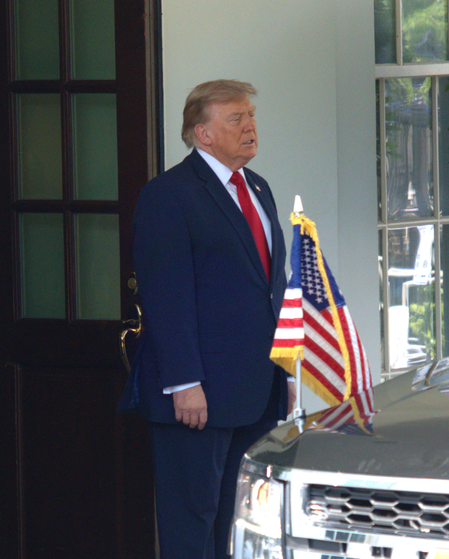
Washington, July 27 (IANS) US President Donald Trump on Monday asserted that the United States holds a substantial lead over China in artificial intelligence (AI), as his administration examines whether Chinese AI companies have benefited from American technology through unauthorised model distillation.
Speaking to reporters aboard Air Force One en route to Michigan, Trump was asked about remarks by Treasury Secretary Scott Bessent, who said last week that the administration would investigate whether Chinese AI models were being trained using outputs from leading US systems.
Asked whether he believed China was stealing American intellectual property, Trump acknowledged the competitive nature of the technology race while insisting the United States remained well ahead.
“Well, you know, we’re, they’re looking at us, and we’re looking at them. But we’re leading now China substantially in AI. And we’re gonna keep it that way,” Trump said.
“We’re gonna keep it that way,” he said.
Artificial intelligence has emerged as one of the principal arenas of strategic rivalry between the world’s two largest economies, with both governments investing heavily in advanced computing, semiconductor technology and next-generation AI models.
The latest remarks come as US officials increasingly express concern that Chinese developers may be using “distillation” techniques to train their own models by drawing on the outputs of advanced American AI systems. The practice has become a growing point of debate within the AI industry because it can allow developers to replicate capabilities without incurring the full cost of training frontier models.
Trump’s comments also reflect the administration’s broader effort to preserve America’s technological edge in sectors viewed as critical to national security and economic competitiveness.
In recent months, the administration has continued to tighten restrictions on the export of advanced AI chips and related technologies, arguing that cutting-edge computing capabilities should not be used to strengthen the military or intelligence capabilities of strategic competitors.
Washington has also encouraged greater domestic investment in AI infrastructure, including semiconductor manufacturing, data centres and energy supplies needed to support increasingly powerful computing systems.
The United States remains home to many of the world’s leading AI developers, while China has made AI self-sufficiency a national priority through large-scale government investment and support for domestic technology firms. The competition extends beyond commercial applications into defence, cybersecurity, scientific research and economic productivity.
The growing US-China AI rivalry is being closely watched globally, including in India, which has emerged as a major AI talent hub and an increasingly important technology partner for the United States. New Delhi has expanded cooperation with Washington on critical and emerging technologies while simultaneously investing in domestic AI capabilities to support economic growth, digital governance and national security.
–IANS
lkj/ksk/dan