


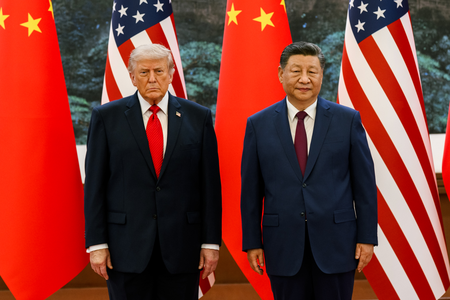
Beijing, May 14 (IANS) The United States and China agreed Thursday that Iran can never have a nuclear weapon and the crucial Strait of Hormuz must remain open, a White House official said after Presidents Donald Trump and Xi Jinping held a high-stakes summit in Beijing.
The leaders had the much-anticipated meeting at the imposing Great Hall of the People, during which they discussed an array of consequential issues, including trade, the ongoing US-Israeli war on Iran and Taiwan, the self-governing democracy China considers part of its territory.
The meeting came amid an impasse in peace negotiations between Washington and Tehran aimed at ending their months-old war and reopening safe passage through the Strait of Hormuz, a key shipping lane for oil, fertiliser, and other commodities.
“The two sides agreed that the Strait of Hormuz must remain open to support the free flow of energy. President Xi also made clear China’s opposition to the militarisation of the strait and any effort to charge a toll for its use,” the official said, casting the Trump-Xi meeting as “good.”
“And he expressed interest in purchasing more American oil to reduce China’s dependence on the strait in the future. Both countries agreed that Iran can never have a nuclear weapon,” the official added.
Their discussions on the Middle East conflict came as Trump seeks to exit the war and restore freedom of navigation in the Strait of Hormuz, particularly ahead of the US midterm elections slated for November.
China itself has been apprehensive about the conflict, as disruptions to shipping in the waterway could imperil its energy supplies. China has sought to shift to alternative energy sources and maintains large oil stockpiles, but the conflict has raised longer-term economic risks for the world’s second-largest economy.
The two sides also discussed ways to enhance economic cooperation between the countries, including expanding market access for American businesses into China and increasing Chinese investment in US industries, the official said without elaborating.
In addition, the leaders highlighted the need to build on progress in ending the flow of fentanyl precursors into the US, as well as increasing Chinese purchases of American agricultural products, according to the official.
At the summit, both Trump and Xi signalled their desire to stably manage bilateral ties, but the Chinese leader staked out Beijing’s firm position on Taiwan, Yonhap news agency reported.
“It’s an honour to be with you. It’s an honour to be your friend, and the relationship between China and the USA is going to be better than ever before,” Trump said in his opening remarks.
The American president also said that he and Xi had known each other for a long time and have had a “fantastic” relationship, while pointing out that whenever the two countries faced difficulties, the two leaders “worked it out very quickly.”
“We are going to have a fantastic future,” he said.
Trump praised Xi as a “great leader,” and highlighted that he was being accompanied by the “greatest” and “best” American business delegation.
“They look forward to trade and doing business, and it’s going to be totally reciprocal on our behalf,” he said.
Xi said a “stable” Sino-US relationship is “good for the world,” expressing his belief that the two countries have more common interests than differences.
“China and the United States both stand to gain from cooperation and lose from confrontation,” he said in his remarks translated through an interpreter.
“We should be partners, not rivals. We should help each other succeed and prosper together, and find the right way for major countries to get along well with each other in the new era,” he added.
Xi told Trump that the Taiwan question is the “most important issue” in US-China relations and that if it is not handled properly, the two countries will have clashes and even “conflicts,” putting the entire relationship “in great jeopardy,” according to Xinhua.
Xi also posed a question about whether the US and China can overcome the “Thucydides Trap” — a term describing the high risk of conflict between an emerging power and an established power due to structural stress.
The question apparently reflected Xi’s hope for the US to recognise China as an equal superpower, observers said, as the Sino-US relationship remains beset by a deepening strategic competition in trade, security and technological leadership.
Prior to their meeting, Trump received a ceremonial welcome marked by a handshake between the two leaders, the performance of national anthems by a military band, an inspection of an honour guard and greetings by young children waving flowers, as well as US and Chinese flags.
Following their talks, the two leaders visited the Temple of Heaven, an imperial complex, and attended a state banquet later in the day.
During the banquet, Trump announced his invitation to Xi and the Chinese first lady Peng Liyuan to visit the White House in Washington on September 24, as he proposed a toast to what he called the “rich and enduring ties” between the American and Chinese people.
He portrayed the conversations with the Chinese side as “positive and productive.”
“Some of the things that we discussed today … all good for the United States and for China,” he said.
During his remarks at the banquet, Xi said achieving the “great rejuvenation” of the Chinese nation and making America great again “can go hand in hand” — a remark that reiterated his call for cooperation with the US rather than confrontation.
“We both believe that the China-US relationship is the most important bilateral relationship in the world,” Xi said through an interpreter. “We must make it work and never mess it up.”
In Beijing, Trump was accompanied by a delegation of prominent US business leaders, reflecting his focus on the economic relationship with China.
They included SpaceX and Tesla’s Elon Musk, Nvidia’s Jensen Huang, Boeing’s Kelly Ortberg, Apple’s Tim Cook, Micron Technology’s Sanjay Mehrotra, Qualcomm’s Cristiano Amon and Goldman Sachs’ David Solomon.
On Friday, the two leaders will have tea and a working luncheon before Trump heads back home.
Trump arrived in the Chinese capital on Wednesday evening for a three-day visit, marking his first trip to China since November 2017. He and Xi last met in person in Busan, South Korea, in late October on the margins of the Asia-Pacific Economic Cooperation summit.
This week’s summit is the first in a series of possible bilateral talks between Trump and Xi this year, including meetings on the margins of the Asia-Pacific Economic Cooperation summit in Shenzhen, China, in November and the Group of 20 gathering in Florida in December.
–IANS
ksk/as