



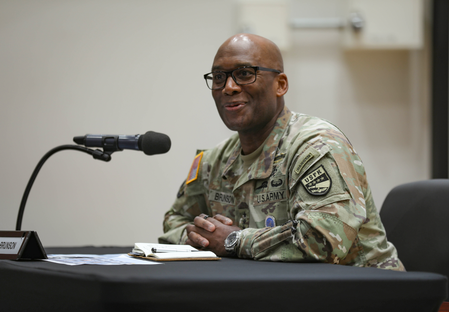
Seoul, Dec 19 (IANS) The commander of the US Forces Korea (USFK) said Friday that the Demilitarized Zone (DMZ) should not be “politicized,” voicing opposition to a bill in South Korea that seeks to grant the government control of non-military access to the buffer zone.
The remarks by USFK Commander General Xavier Brunson, who also doubles as commander of the UN Command (UNC), followed a recent UNC statement in opposition to the pending bill.
He said the armistice agreement that ended the 1950-53 Korean War should remain the barometer governing behavior. Under the armistice, the UNC currently has the authority to approve or deny access to the DMZ, Yonhap News Agency reported.
“What we want to try to make sure that we do is, number one, we don’t allow that area to become politicized … we signed an agreement to say that we will maintain this buffer here,” Brunson said in an episode of security-focused podcast series “War on the Rocks.”
Brunson noted that South Korea recently proposed military talks with North Korea to discuss how to clarify the Military Demarcation Line in the DMZ in a bid to prevent possible clashes near the inter-Korean border, but emphasized that all actions should be based on the armistice agreement.
“What governs our behaviour is the armistice, and we’ve got to adhere to the standards put forward in the armistice. And as long as we do that, there won’t be any challenges,” he said. “What we can’t do is seek to change the way we do business in abrogation of a legal document, which is the armistice.”
The USFK commander’s call urging the need to adhere to the armistice came just days after the UNC issued a rare statement underscoring its role as the “administrator” of the DMZ, which stretches about 250 kilometers in length and 4 km in width, and has served as a buffer between the two Koreas since the end of the Korean War.
Speaking on Seoul’s plan to seek a conditions-based handover of wartime operational control from Washington within President Lee Jae Myung’s five-year term ending in 2030, Brunson said the United States has no intention to “hold this up at all.”
He still emphasized that the bilaterally agreed-upon conditions should be met for the transfer.
“We’ve got to make sure that we’ve met all those conditions whether they be operational, whether they be material based, whether it might be something as simple as protection that those things are all in place before we go and do this,” he said.
Against such a backdrop, Brunson touted how South Korea’s “thriving” defence industry and participation in multinational drills like Talisman Sabre, held in Australia, have strengthened its capabilities as well as role in the wider Indo-Pacific region and called on the country to further “pull away from the Peninsula and become more engaged.”
“I’ve talked a lot about the centrality and importance of the Republic of Korea to the entirety of the Indo-Pacific by virtue of their economy, by virtue of the size of their military, by virtue of their ability to continue to develop technologies,” he said, referring to South Korea by its formal name.
“They are just preeminently important to peace in the Indo-Pacific.”
–IANS
akl/as