



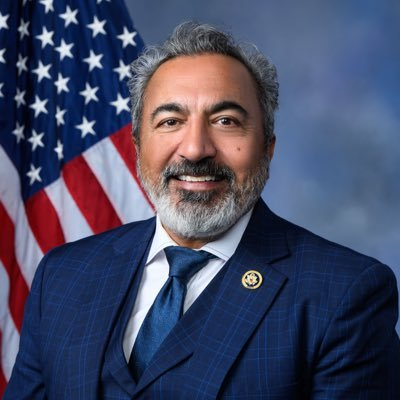
Washington, May 19 (IANS) Indian American Congressman Ami Bera said the long-term strategic foundations of the US-India relationship remained intact despite recent tensions over trade, tariffs and immigration policies under President Donald Trump’s administration.
Speaking at the Capitol Hill Summit 2026 organised by the US-India Friendship Council, Bera described India as a critical geopolitical and economic partner for the United States in the 21st century.
“Nothing fundamentally has changed about our long-term strategic interest,” Bera said during a panel discussion on defence, technology and energy cooperation.
The California Democrat acknowledged that disagreements over tariffs and trade had created friction between Washington and New Delhi, but argued that Congress continued to strongly support closer engagement with India.
“From the congressional perspective, nothing really has changed going back three decades,” he said.
Bera said ties between the two countries had steadily expanded under successive administrations — from President Bill Clinton through George W. Bush, Barack Obama, Donald Trump’s first term and Joe Biden — particularly in defence and strategic cooperation.
“The defence-to-defence base is strong and tight,” he said.
At the same time, Bera said India would increasingly have to assume greater global responsibilities as it emerged as a major world power.
“India has its own aspirations,” he said. “Fastest growing economy in the world. It has to decide who it wants to be as it enters this place of world leadership.”
The congressman argued that India could play an important diplomatic role in helping end the war in Ukraine because of its longstanding relationship with Russia.
“India can play a very constructive role in helping bring the war in Ukraine to an end,” Bera said. “It has lines of communications with Russia.”
He also said India’s role in the Indian Ocean region and Indo-Pacific security architecture would become increasingly important.
Bera criticised some voices within the Trump administration that he said had taken an anti-India approach on trade and immigration.
“I do think there’s folks like Peter Navarro and others inside the administration that are very anti-Indian,” he said.
On immigration, Bera strongly defended Indian students and professionals in the United States, describing Indian Americans as one of the country’s most successful immigrant communities.
“It’s the most educated demographic in the United States,” he said, while discussing proposed legislation aimed at protecting documented dreamers and visa holders.
Bera also urged Indian Americans to become more politically engaged and build stronger relationships with members of Congress.
“Get to know your member of Congress,” he said. “We’re the ones that write the bills, we’re the ones that write the legislation.”
During the panel discussion, Bera highlighted emerging areas of cooperation between India and the United States, including artificial intelligence, critical minerals and semiconductor supply chains.
“The leading tech CEOs in the United States are Indian Americans,” he said. “We should be jointly developing these solutions together.”
Bera, a physician by training, has represented California in the US House of Representatives since 2013 and currently serves on the House Foreign Affairs Committee and the House Permanent Select Committee on Intelligence.
–IANS
lkj/rs