




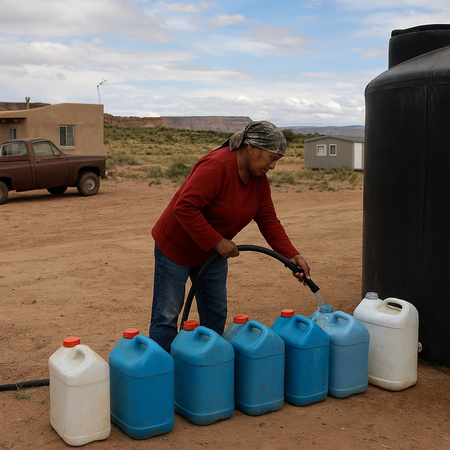
Washington, March 3 (IANS) In the world’s largest economy, entire Native American communities still haul water for miles, rely on crumbling irrigation systems, and face fiscal collapse after the closure of a single mine, a reality laid bare at a U.S. Senate hearing that underscored the stark development gaps inside the United States.
At a Senate Committee on Indian Affairs session, tribal leaders described living conditions more commonly associated with drought-stricken developing regions than with a G7 country.
Navajo Nation President Dr. Buu Nygren told lawmakers that “Roughly, a third of the Navajo Nation households lack running water, and that is how I grew up, without running water.” He said thousands of families haul water “over 30 miles round trip on unpaved dirt roads, washboard roads, to meet the daily water demands.”
The Navajo Nation is the largest indigenous nation in the country.
The cost disparity is equally striking. Families who haul water “spend the equivalent of $43,000 per acre foot, compared with $600 per acre foot from a typical suburban water user in the region,” Nygren said. He called it “absolutely unacceptable, in 2024, more than one-third of our people, including our children and our elders, do not have running water.”
The hearing focused heavily on a proposed $5 billion water settlement for tribes in northeastern Arizona. Interior Department official Bryan Newland said the measure “will provide reliable and safe water” and “authorize $5 billion for essential water development and delivery projects.” The department supports the bill’s “goals and purposes,” he said, though “important issues” still need to be addressed.
For the Hopi Tribe, the infrastructure deficit is similar. Chairman Timothy Nuvangyaoma said, “On our reservation, approximately 30 percent of Hopis lack running water.” He framed water access as fundamental to survival and culture. “Water is sacred. Water is our life.”
The Zuni Tribe in neighboring New Mexico described the collapse of traditional agriculture after upstream diversions and failed federal dams. Governor Arden Kucate said the once-perennial Zuni River “is now a bare trickle.” The proposed settlement would fund the rehabilitation of irrigation systems and the construction of modern drinking water and wastewater facilities.
In Montana, Crow Tribe Chairman Frank White Clay warned senators that the closure of a major coal mine triggered “a 95 percent reduction in revenue.” He said the tribe is facing a fiscal “cliff,” with funds for elders, social services, and public safety at risk.
The testimony offered a stark contrast. The United States leads globally in GDP and technological innovation. At the same time, some Indigenous nations within its borders still struggle for basic utilities. Large-scale settlements require congressional approval and can take decades to negotiate, leaving communities in limbo.
–IANS
lkj/dan