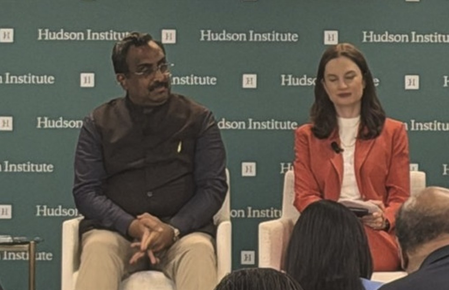




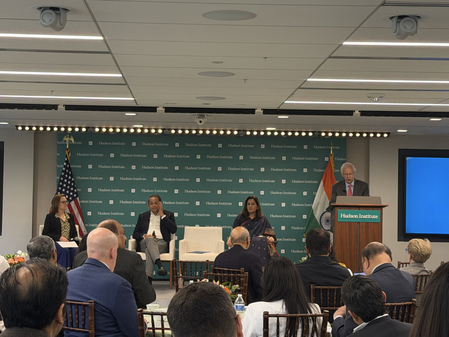
Washington, April 24 (IANS) The role of Pakistan in US strategy triggered sharp debate among policymakers, with speakers at the Hudson Institute warning against diluting Washington’s focus on India even as some argued for parallel engagement with Islamabad.
Kurt Campbell, former US Deputy Secretary of State, took a firm position, saying American strategic interests should be clearly anchored in India. “Peace and stability are reinforced… by a closer relationship between the United States and India, and an absolute clarity that all our strategic interests lie in Delhi,” he said.
He added that while communication with Pakistan may continue, “the India relationship is in capital letters and Pakistan really doesn’t even appear in the paragraph.”
Ram Madhav echoed concerns over the continued “hyphenation” of India and Pakistan in US policy thinking. “India’s relationship is much bigger, much wider… that one should not make,” he said, stressing that the two ties operate at entirely different levels.
However, Elizabeth Threlkeld offered a more nuanced view, arguing that US engagement with both countries need not be zero-sum. “I genuinely think that there is room for a relationship with both Islamabad and New Delhi,” she said.
She noted that Pakistan’s role in ongoing regional crises could be relevant in facilitating outcomes. “If Pakistan can leverage the relationships that it has… I think all the better,” she said, adding that managing ties with both capitals is important given escalation risks in South Asia.
The discussion came amid broader concerns about US policy shifts, including closer engagement with Pakistan in the context of Middle East dynamics and evolving China policy.
Campbell acknowledged that uncertainty in Washington’s strategic direction has contributed to anxiety among partners. “There are many elements… that are not clear,” he said, describing a policy approach marked by “ambiguity” and competing internal views.
He warned that such uncertainty risks undermining confidence among key partners, including India, particularly at a time of global instability.
The panel also linked the debate to wider geopolitical developments, including conflict in the Middle East and its spillover effects on supply chains and security calculations.
Speakers agreed that while tactical engagement with Pakistan may continue, the long-term trajectory of US strategy in the Indo-Pacific will be shaped primarily by its partnership with India.
The New India Conference convened senior officials and analysts to assess India’s global role and evolving strategic partnerships.
The US has historically balanced ties with both India and Pakistan, particularly during periods of crisis in South Asia. However, over the past two decades, Washington has significantly deepened its engagement with New Delhi, reflecting India’s growing economic and strategic importance.
–IANS
lkj/dan