




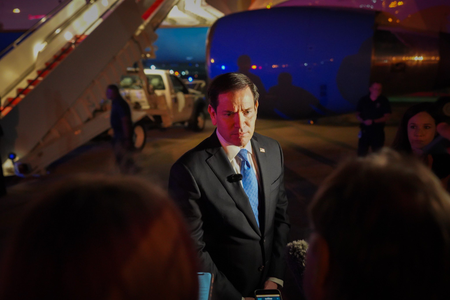
New Delhi/Washington, July 20 (IANS) US Secretary of State Marco Rubio has left for Philippines to attend the ASEAN meetings and hold discussions with foreign ministers from the Quad grouping.
US Ambassador to India, Sergio Gor stated that he is looking forward to the second Quad ministerial meeting of the year and expressed Washington’s commitment to a free and open Indo-Pacific.
“Looking forward to joining Marco Rubio this week in the Philippines for our second Ministerial Quad meeting of the year. The United States is committed to a free and open Indo-Pacific, our Quad partners are essential,” Gor posted on X.
Quad brings together four countries – India, Australia, Japan, and the United States, with a commitment to work as a force for global good and to support an open, free, and inclusive Indo-Pacific that is prosperous and resilient.
Rubio is travelling to Philippines to attend the ASEAN Post-Ministerial Conference, the East Asia Summit Foreign Ministers’ Meeting, and the ASEAN Regional Forum Foreign Ministers’ Meeting. He is scheduled to meet senior government officials from Indo-Pacific nations, according to a statement released by the US Department of State spokesperson Tommy Pigott.
“The Secretary’s visit advances a clear U.S. priority: a free and open Indo-Pacific that delivers safety, security, and prosperity for the region and for the American people. Secretary Rubio will use this trip to demonstrate the tangible results of US-ASEAN partnership and to deepen the United States’ comprehensive partnership with the Philippines,” Pigott mentioned.
In May, External Affairs Minister (EAM) S Jaishankar, Australian Foreign Minister Penny Wong, US Secretary of State Marco Rubio and Japanese Foreign Minister Toshimitsu Motegi participated in the Quad Foreign Ministers’ Meeting.
The Foreign Ministers of the Quad nations reiterated their support for a free and open Indo-Pacific and agreed to further enhance cooperation and advance concrete initiatives to deliver tangible benefits to the Indo-Pacific.
The joint statement released following the meeting said, “We remain seriously concerned about the situation in the East China Sea and the South China Sea. We reiterate our strong opposition to any destabilising or unilateral actions, including by force or coercion, that threaten peace and stability in the region.”
“We express our serious concerns regarding dangerous and coercive actions, including interference with offshore resource development, the repeated obstruction of freedom of navigation and overflight, and the dangerous manoeuvres by military aircraft and coast guard and maritime militia vessels, especially the unsafe use of water cannons and flares, and ramming or blocking actions in the South China Sea. We are seriously concerned by the militarisation of disputed features,” it added.
–IANS
akl/as