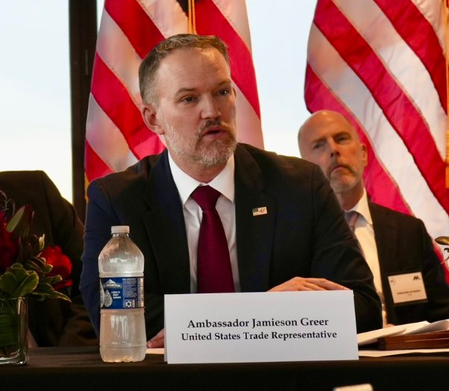
Milwaukee, Oct 1 (IANS) US Trade Representative Jamieson Greer called on G20 economies to help build a “new international economic order”, arguing that the global trading system designed decades ago is no longer equipped to address excess production, economic coercion, forced labour and other challenges.
Opening the G20 Trade Ministerial in Milwaukee on Wednesday (local time), Greer said the United States wanted candid discussions on four issues: the weaponisation of food, structural excess capacity and production, the Most-Favoured-Nation principle and forced labour in global supply chains.
“Here in Milwaukee, we gather as possible architects of a new international economic order,” Greer told ministers and delegates.
“The topics we will talk about at our meetings — weaponisation of food, structural excess capacity and production, MFN and forced labour — are ongoing challenges, the solutions to which expose the overall problem: we are trying to meet 21st century challenges with an architecture designed for another era,” he said.
Greer said the United States had already moved to reshape its trade relationships through tariffs and bilateral agreements.
“This is why, starting last year, the United States took action, using a combination of tariffs and bilateral deals to reduce our trade deficit, make our supply chains more resilient, and bring fairness, reciprocity, and balance to the global economy,” he said.
He also questioned whether unconditional application of the MFN principle continued to serve the needs of the international trading system.
“Many consider MFN to be the cornerstone of the global trading system. But even a cornerstone should be examined from time to time to ensure it is still supporting the structure we need,” Greer said.
“The MFN principle, particularly when applied unconditionally, constrains economies’ ability to effectively respond to distortive policies and adapt to changing market conditions,” he added.
On excess capacity, Greer said non-market policies that encouraged production far beyond domestic demand had consequences across borders, placing pressure on producers and workers in other economies.
He also described forced labour as both a humanitarian and trade issue because goods produced through such labour could enter markets with an artificial price advantage.
Greer urged G20 members not to push difficult trade questions back to the World Trade Organization in Geneva.
“Typically, and too often, when difficult questions and topics arise in the G20, many around the room suggest that such discussions belong elsewhere. That they should take place in Geneva at the WTO. But Geneva is just another city on a lake. And so is Milwaukee. So, let’s talk candidly and constructively here,” he said.
The US trade representative also brought India’s Commerce and Industry Minister Piyush Goyal into a lighter moment while describing reform of the trading system as a long-term undertaking.
“Just as Antonio Gaudi started the ongoing work to build the Sagrada Familia in Barcelona in 1883, work to establish a trading system that is more balanced and fair will continue long after our tenures in office — maybe except for Piyush who is trade minister for life!” Greer said.
He said reform did not require countries to abandon everything inherited from the existing system, but argued that older ideas should not remain unchanged simply because they had shaped international trade for decades.
Greer recalled that G20 leaders had committed in 2016 to tackle excess industrial capacity. Ten years later, he said, the problem had become an even greater distortion in the global economy.
The Milwaukee ministerial is part of the US G20 presidency ahead of the G20 Leaders’ Summit, which the United States is preparing to host for the first time on American soil since 2009. Greer said the two-day trade meeting was intended to create a greater sense of urgency and recognition among participating economies that action was needed.
He framed Milwaukee, historically associated with manufacturing, as an appropriate setting for the debate. Earlier in the day, delegates visited a Rockwell Automation production facility. Greer said the visit illustrated the kind of production-oriented economy the Trump administration wanted to encourage and the benefits it believes can flow from a more balanced, fair and reciprocal trading system.
–IANS
lkj/sd/