



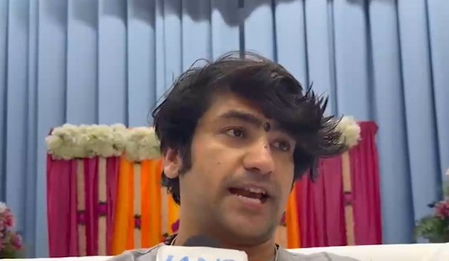
Tokyo, Aug 24 (IANS) Pandit Dhirendra Shastri, the head priest of Bageshwar Dham, on Monday said that the idea of ‘Hindu Rashtra’ (Hindu nation) is necessary, and to do that, one needs to instill the Sanatan culture in the hearts of every Indian.
Shastri, who is on a visit to Japan, spoke exclusively with IANS and said that a Hindu Rashtra should exist in thoughts, while adding that the biggest problem the Hindu society is facing is casteism and regionalism. He said that India should learn to break away from these challenges and take a lesson from Japan. He also spoke about current challenges faced by India, Gen Z and the problems faced by them, etc.
Following are the excerpts from the interview:
IANS: Everyone says that a Hindu Rashtra is against the Constitution. What would you like to say about this?
Dhirendra Shastri: We want a Hindu Rashtra not on paper, but in thoughts. A change in thought will lead to a change in action. A change in thought will lead to a change in the nation. Our vision of a Hindu nation is ideological, not on paper.
IANS: What is the problem in creating a Hindu nation?
Dhirendra Shastri: There is no problem in creating a Hindu nation. We need to instill the Indian tradition, Sanatan culture, in the hearts of children, the elderly, and every Indian. The only problem is that this should be universally accepted, and everyone should become cultured, thoughtful, wise, intelligent, strong, and wise.
IANS: What is the biggest problem facing Hindu society?
Dhirendra Shastri: The biggest problem facing Hindu society is regionalism and casteism.
IANS: The current generation — Gen Z — is focused on Instagram; they open their feeds first thing in the morning. What would you like to say about this?
Dhirendra Shastri: Instagram should be used. It’s good for proper use, bad for misuse. Being active on social media is fine, but only for proper use. Learn good values, spend less time on the screen, and rely more on real things than reels. Don’t just get obsessed with going viral. Rushing isn’t the only important thing in life; patience is also very important, and happiness is also very important. Using reels and Instagram isn’t bad, but using them excessively and misusing them is bad.
IANS: What should India learn from Japan?
Dhirendra Shastri: India should also learn a lot from Japanese culture, rules and regulations, system, infrastructure, the happiness of the Japanese people, their long life, and their extreme physical well-being. There is no regionalism or casteism in Japan, there is Rashtrism (nationalism) here.
IANS: What should Japan learn from India?
Dhirendra Shastri: Japan should learn from India how to promote culture among the youth and practice unity in diversity. Additionally, one thing Japan should learn is spirituality.
IANS: If today a Gen Z said, “If I don’t have proof, I won’t believe in God,” what would you say about that?
Dhirendra Shastri: Not everything in this world is provable. There are things that exist even without proof. What is not visible in this world doesn’t necessarily mean it doesn’t exist. Air is invisible, but it is there. Similarly, God is invisible, but he is there. If someone hasn’t seen America, it doesn’t mean that America doesn’t exist. It’s not necessary to emphasise seeing, because God isn’t something to be seen; God is something to be experienced, and that too within oneself.”
IANS: How are you feeling after coming to Japan?
Dhirendra Shastri: India is India, ‘Saare Jahan se acha, Hindustan humara’, there’s no doubt about that. But after coming to Japan, I really liked the technology and infrastructure here. They have very good thinking and are simple, humble, and rule-abiding people. We thank Japan, its government and people.
IANS: If you had to seek Lord Hanuman’s blessings for something to change India, what would you ask for?
Dhirendra Shastri: Improvement in education and health.
–IANS
sd/mr