Jaipur, June 24 (IANS) On most mornings, commuters boarding Jaipur’s city buses expect traffic jams, crowded seats, and the rush of getting to work on time. What they do not expect is to find themselves trapped inside a brand-new “smart” electric bus with doors locked, a siren blaring, and no immediate way out.
That is exactly what happened on Tuesday near Kumbha Marg on Tonk Road.
Around 30 passengers were travelling in one of Jaipur’s newly launched electric smart buses when the vehicle suddenly came to a halt.
Within moments, a loud emergency siren began echoing through the bus. Before passengers could understand what was happening, the doors automatically locked. Confusion quickly spread through the cabin. Some passengers looked towards the driver for answers. Others attempted to figure out why the siren would not stop.
For nearly ten minutes, the bus remained stationary while anxious commuters searched for a way to get out. Eventually, a passenger managed to operate the emergency mechanism near the door, releasing the air-pressure system and allowing the doors to open.
The trapped passengers finally stepped out, relieved but bewildered by what had just unfolded. When mechanics later inspected the bus, they reportedly discovered an unlikely culprit: nothing but a matchstick.
According to depot officials, someone had inserted the tiny wooden stick into the Panic SOS button, a safety feature installed in the new buses. The obstruction activated the emergency system, triggering the siren and locking the doors as part of the vehicle’s safety protocol.
The incident serves as a reminder of how modern technology can sometimes be disrupted by the simplest of objects.
A feature designed to enhance passenger security ended up creating panic because of what appears to have been a minor act of tampering. The episode has also exposed a larger challenge that often accompanies technological upgrades in public transport systems.
Jaipur’s new electric buses are equipped with several modern features, including surveillance systems, digital monitoring, and Panic SOS buttons intended to improve commuter safety, especially for women passengers. According to Todi Depot Manager Anil Pareek, preliminary investigations revealed that a passenger had inserted a matchstick into the bus’s Panic SOS button.
“A passenger appears to have inserted a matchstick into the Panic SOS button. This activated the emergency system, causing the siren to sound and the doors to lock as part of the vehicle’s safety protocol. The system was later reset, and normal operations were restored,” Pareek said.
The incident, which unfolded near Kumbha Marg on Tuesday morning, has triggered questions not only about passenger awareness of modern safety systems but also about whether drivers and conductors have received adequate training to deal with such situations in Jaipur’s new fleet of technology-driven buses.
Passengers were eventually rescued, but not before spending several anxious minutes inside the locked vehicle. More notably, the driver and conductor reportedly could not immediately resolve the issue themselves and had to wait for technical assistance. The timing of the incident has added another layer of intrigue.
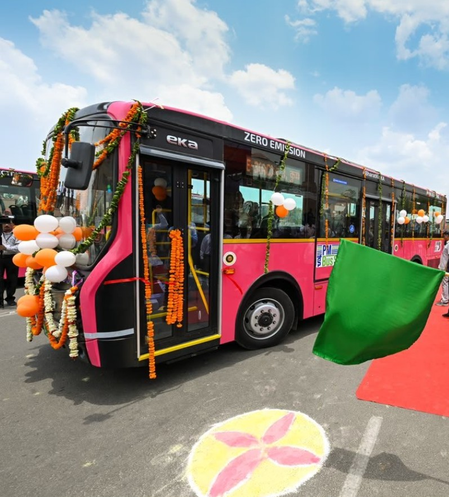
Only three days earlier, Chief Minister Bhajanlal Sharma had flagged off a fleet of 29 electric smart buses in Jaipur and 18 in Bhilwara under the Prime Minister’s e-Bus Service Scheme. The launch was showcased as a step towards cleaner, smarter, and safer urban mobility. For city residents, Tuesday’s incident became an unexpected real-world stress test of that promise. Fortunately, no one was injured.
The incident highlights an important lesson for modern public transport systems: technology alone is not enough. Every smart feature must be backed by public awareness, technical preparedness, and comprehensive staff training. After all, in an era of intelligent buses and automated safety systems, sometimes the biggest disruption can come not from a software failure or a power outage but from something as small as a matchstick.
–IANS
arc/skp