




NEW DELHI,
November 10
Indian Abroad Newsdesk
The World Health Organization (WHO) has brought together more than 240 organisations under a new global initiative aimed at rebuilding public confidence in science and ensuring that scientific knowledge plays a greater role in improving health and people’s lives.
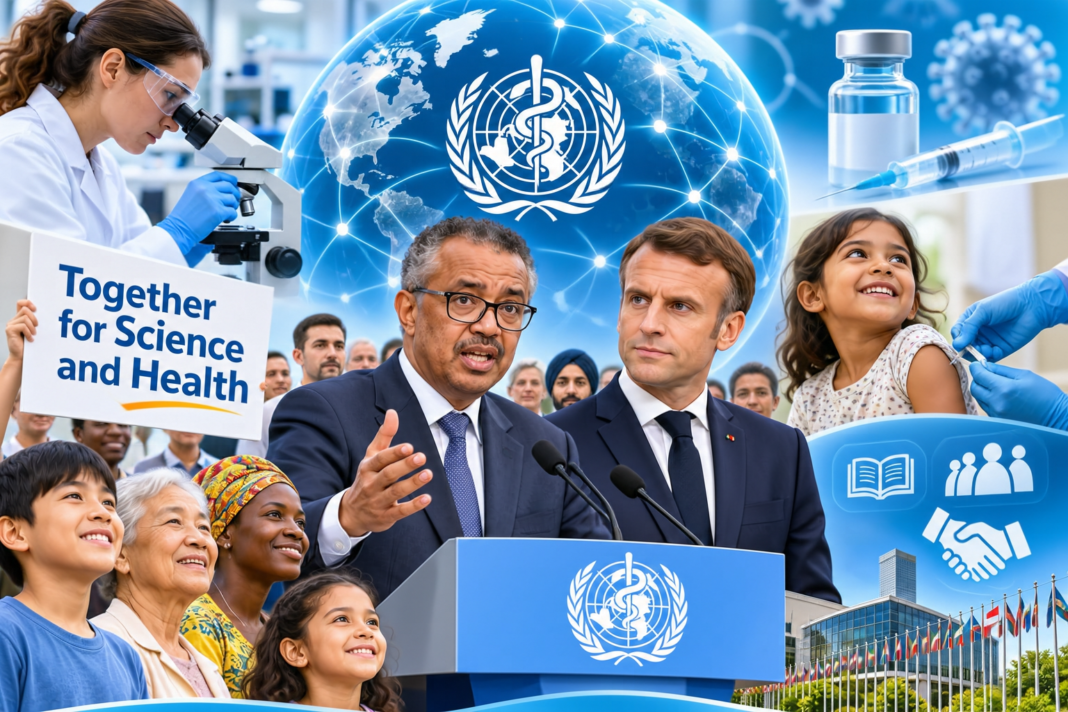
Called Together for Science and Health, the movement was launched on November 10, with a clear message that scientific progress must be supported by public trust, open communication and cooperation across societies. In its official announcement, the WHO said the initiative would unite organisations around a common goal of promoting science as a tool for better health and development.
The launch coincided with World Science Day for Peace and Development and was marked by 12 events across different countries and regions. According to the WHO, scientists, policymakers, institutional representatives and leaders from various sectors are being brought into the initiative. The launch is also linked to the Paris Peace Forum, an international platform that promotes dialogue and cooperation on global issues.
WHO Director-General Dr Tedros Adhanom Ghebreyesus and French President Emmanuel Macron are leading the initiative. In its announcement, the WHO highlighted Dr Tedros’s view that science has consistently helped humanity overcome major health challenges. Vaccines, medicines, disease prevention and improved responses to outbreaks were among the advances he cited as examples of science making a direct difference to people’s lives.
Dr Tedros said the new movement would encourage governments, institutions and other partners to place greater emphasis on reliable evidence, public trust and innovation. He also stressed that scientific progress should contribute to healthier societies rather than remain confined to research institutions and laboratories, according to the WHO statement.
The movement will concentrate on three broad areas. The first is to bring science closer to ordinary people and make it easier for communities to understand its relevance to everyday life. The second is to encourage policymakers to rely more consistently on scientific evidence when framing health policies. The third is to improve the way scientific findings are communicated and discussed with the public.
According to the WHO, participating organisations will share knowledge, resources and practical experience while building partnerships to address common challenges. The aim is to make scientific information more accessible and help ensure that the benefits of research reach communities across different countries.
WHO Chief Scientist and Assistant Director-General for Health Systems, Access and Data, Dr Sylvie Briand, said building trust in science required the involvement of society as a whole. She observed that no single institution, country or community could achieve this on its own. The movement, she said, would create opportunities for discussion and cooperation, bringing different groups together around the idea that science is a shared resource for healthier and more resilient societies.
The WHO also drew attention to the changing information landscape, particularly the growing influence of artificial intelligence and rapid technological developments. These changes are transforming how people find, understand and share scientific and health information. The organisation said stronger links between science and society would help people assess evidence and make informed decisions with greater confidence.
The initiative reflects the WHO’s wider effort to address concerns about misinformation and public confidence in scientific information. In a separate report published on November 6, the organisation highlighted discussions involving civil society groups, health professionals and community organisations on ways to strengthen trust. Those discussions underlined the importance of clear communication, public participation and credible local voices in helping communities make informed health choices.
The WHO has invited organisations and institutions around the world to become part of Together for Science and Health by contributing their expertise, experience and networks. Its broader objective is to turn scientific knowledge into practical improvements in public health and ensure that progress in research and innovation benefits people across societies.