



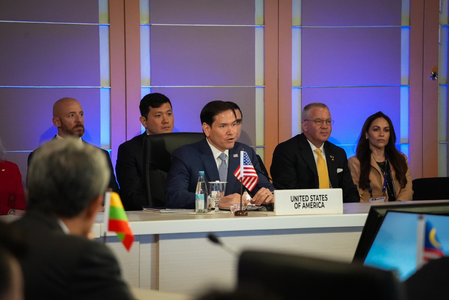
Washington/Manila, July 23 (IANS) Secretary of State Marco Rubio has said that his lengthy meeting with Chinese Foreign Minister Wang Yi focused on laying the groundwork for Chinese President Xi Jinping’s planned visit to the US in September, while stressing that Washington and Beijing must continue talking despite big strategic differences.
Speaking to reporters after the meeting on the sidelines of ASEAN-related meetings in Manila on Wednesday (Washington time), Rubio said the extended talks reflected the time needed for translation rather than any tension between the two sides.
“We talked a lot about the visit in September, and that was really the gist of it,” Rubio said. “It was just to create the groundwork for another positive visit. I think President Xi will have a very positive visit when he comes to Washington.”
In response to a question, Rubio described the United States and China as “the two most powerful countries in the world,” particularly in economic terms, and said maintaining communication was essential even as major disagreements persist.
“We have to have a relationship,” he said. “There are areas of great differences. Both sides will acknowledge that. We’ll have to work through those. And I think these differences will exist for the foreseeable future, and our job is to sort of manage those so that they never get out of control.”
He said officials from both countries would use the weeks before the September summit to identify areas where cooperation is possible and produce “concrete deliverables.”
Rubio said the two sides also discussed implementing mechanisms agreed during earlier engagements, including trade and investment initiatives.
“We’re moving towards implementation of that, and I think that’s one of the potential concrete deliverables that we can have before September,” he said.
Asked whether he had raised allegations of Chinese election interference, Rubio gave a brief reply: “We didn’t discuss that topic.”
On Taiwan, Rubio said the issue arose in every meeting with Chinese officials because Washington opposed Beijing’s military activities around the island.
“We actually think that they run contrary to the spirit of what we’re trying to work out with them with regards to strategic stability,” he said.
He reaffirmed that the United States would continue freedom of navigation operations and honour its treaty commitments to regional allies, including the Philippines.
“We’re never going to accept that international waterways are somehow under the control of other countries,” Rubio said.
Rubio also suggested that Beijing had been constructive on at least one aspect of the conflict involving Iran by publicly opposing restrictions on commercial shipping through the Strait of Hormuz.
“I don’t think they’re big fans of what Iran is trying to do in the straits,” he said, adding that China had opposed “tolling or any sort of restraint on freedom of navigation in the straits.”
Later, he said China’s public position against restrictions on international shipping was “important.”
The Secretary also said progress had been made in bilateral cooperation on combating fentanyl trafficking.
“We’ve made some progress,” Rubio said, noting that law enforcement agencies from both countries continued to engage, although “not entirely where we need to be.”
On India, Rubio disclosed that External Affairs Minister S. Jaishankar did not raise US tariffs on generic pharmaceutical imports during their discussions, despite concerns over the issue.
“I would expect them to be concerned about it, but they didn’t raise it today,” Rubio said. “They might have with others in our system, because we obviously deal with the Indians; we’re very close to them.”
Rubio repeatedly argued that sustained engagement with China remained essential despite strategic rivalry.
“It would, frankly, be reckless and irresponsible for the US and China not to have a relationship, given the impact our countries have on the global economy and on the world,” he said, drawing a parallel with US-Soviet communications during the Cold War that helped prevent catastrophe.
The remarks come as the Trump administration seeks to stabilise ties with Beijing while continuing to compete with China on trade, technology, security and influence in the Indo-Pacific.
Relations between the world’s two largest economies have remained strained over Taiwan, export controls, military activity in the South China Sea and broader strategic competition.
Xi’s expected visit to Washington in September would mark the highest-level US-China engagement since President Donald Trump returned to office.
–IANS
lkj/sd/