



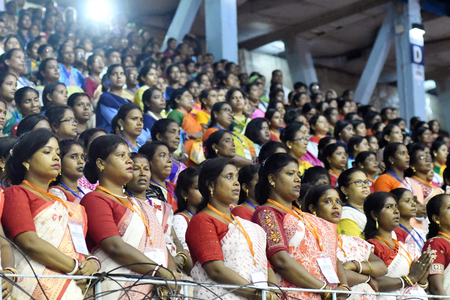
New Delhi, July 6 (IANS) Cash transfer schemes launched in Maharashtra and Odisha for the uplift of poor women have enabled beneficiaries to build higher savings along with higher expenditure on medical and education-related needs that benefited the entire family, according to a working paper published by the Economic Advisory Council to the Prime Minister.
The paper, titled ‘Unconditional Women Cash Transfer Programmes in India: Evidence from Maharashtra and Odisha’, states that the findings indicate the cash transfers not only improved beneficiaries’ savings positions but also enhanced their consumption capacity.
The report said that taken together, the results suggest that recipients allocated a portion of the transfer towards immediate household expenditure while simultaneously retaining a significant share as savings, reflecting improved financial resilience and liquidity.
The conclusion is based on a detailed study of Maharashtra’s Mukhyamantri Majhi Ladki Bahin Yojana and Odisha’s Subhadra Yojana, using monthly data from individual bank accounts. The Maharashtra scheme provides Rs 1,500 per month or Rs 18,000 per annum to women covered under the scheme, while Odisha’s Subhadra Yojana provides Rs 10,000 in two instalments over the year.
The study highlights that Maharashtra’s Ladki Bahin programme raised beneficiaries’ month-end balances by about 84 per cent, or Rs 6,884 per beneficiary, while monthly spending rose by 46 per cent, or Rs 1,349.
Since the monthly transfer amount is Rs 1,500, the estimated marginal propensity to consume was around 0.90 for Maharashtra’s monthly transfers, suggesting beneficiaries spent nearly 90 paise of every additional rupee received while still accumulating savings, reflecting significant liquidity constraints among low-income households.
The paper noted that both programmes generated positive household spillover effects, improving the financial positions of family members while reducing their expenditure outflows.
The paper said that such results are in line with global trends that show women-focused transfers generate stronger developmental outcomes than gender-neutral transfers, but in India, the digital story has revolutionised these payment mechanisms.
It suggested that both programmes should be sustained and evolved toward cash-plus architectures that combine income transfers with voluntary capacity-building, digital literacy, and SHG linkage components.
Beneficiary targeting should be strengthened progressively through hybrid multidimensional verification frameworks that enhance precision while ensuring no deserving woman is excluded.
–IANS
sps/dan