




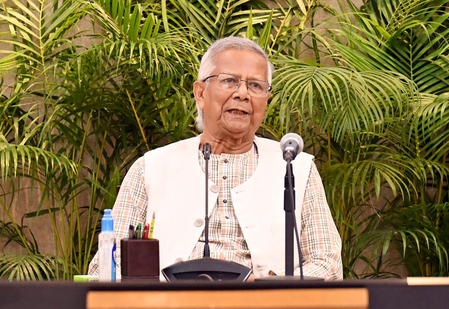
Dhaka, June 29 ( IANS) The 18-month tenure of the former interim government in Bangladesh led by Muhammad Yunus remains deeply contentious, with critics accusing the then administration of pursuing a politics of vengeance marked by widespread arrests and prolonged detention of lawyers, politicians, journalists, academics, and political activists.
They have also questioned the absence of publicly available records detailing how many individuals were arrested, formally charged, or ultimately prosecuted during the period, a report has stated.
“One of the key promises of the interim government was to carry out comprehensive reforms of state institutions. Instead, critics contend that governance became increasingly dominated by unelected civil society figures – many of whom reportedly held foreign citizenships, an influential ‘kitchen cabinet,’ and other vested interests that exercised considerable influence without democratic accountability,” according to a report in Bangladesh’s newspaper ‘Daily Sun’.
The report said that another major criticism of the interim administration was the alleged politicisation of state institutions. Citing critics, it noted that the political instability during the interim period enabled the Jamaat-e-Islami and the National Citizen Party (NCP) to expand their influence within sections of the bureaucracy and other state institutions. Rather than improving governance, critics argue, the period was characterised by growing “patronage, self-aggrandisement, and corruption”.
“These concerns have been reinforced by recent findings from Transparency International Bangladesh, which reported deterioration in corruption indicators during the interim administration. Critics argue that, despite its promises of clean governance, the interim government itself operated with virtually no effective mechanisms of accountability. Unlike elected governments, its advisors were not subject to meaningful parliamentary oversight or public scrutiny,” the report mentioned.
According to the report, the signing of the US-Bangladesh Agreement on Reciprocal Trade during the interim regime has sparked debate. While supporters view the pact as a significant step toward deepening bilateral economic ties, critics contend that it primarily advances American strategic and commercial interests at the potential expense of Bangladesh’s long-term economic sovereignty.
The report stressed that the deterioration in law and order emerged as perhaps the most visible source of public disappointment during the period.
“Mob violence became increasingly frequent, while groups identifying themselves as ‘Tawhidi Janata’ appeared to operate with growing confidence. Critics allege that the interim government failed to confront such groups decisively, creating an atmosphere where extra-legal actions became increasingly normalised and public confidence in law enforcement steadily declined,” the Daily Sun report highlighted.
Many observers, it said, were equally concerned over the shrinking space for intellectual and cultural expression in Bangladesh during the tenure of the interim government.
“Artists, academics, writers, and cultural organisations reportedly found themselves increasingly marginalised or reluctant to voice dissent. Rather than fostering pluralism, critics argue that the administration frequently used labels such as ‘fascist’ to discredit political opponents and silence legitimate criticism,” the report added.
–IANS
scor/ksk/as