



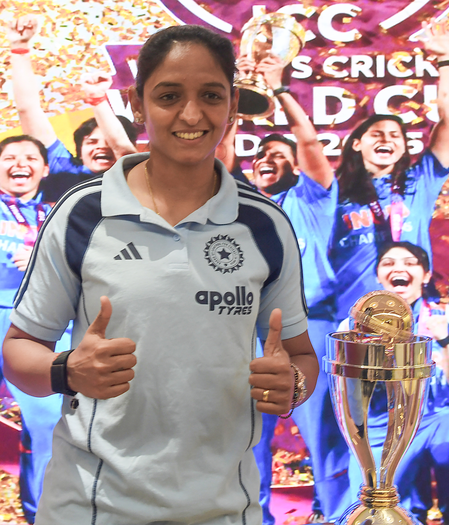
New Delhi, June 7 (IANS) India skipper Harmanpreet Kaur has a knack for keeping things simple, even as the noise around the upcoming Women’s T20 World Cup has started to take centrestage. The chatter about India being in the ‘group of death’, batting frailties or the scars of the group stage exit in the 2024 Women’s T20 World Cup fades quickly when she speaks with the utmost clarity.
Hardened by previous setbacks at global events, India finally broke the trophy drought with the ODI World Cup won at home in 2025. Now, India seeks to clinch its first Women’s T20 World Cup title in England and Wales, expectations from all quarters are on a high when Harmanpreet & Co. take the field on June 14 against Pakistan in Birmingham.
But Harmanpreet insists that one thing has still not changed – of not letting expectations distracting one from their usual process to achieve glory. “With success naturally comes more expectations, but I see that as a positive sign for women’s cricket. It shows that people are emotionally invested in the team and are following our journey closely.
“Personally, I try not to think too much about outside pressure. My focus remains on preparation, contributing to the team, and staying present in the moment. Over the years, I have realised that expectations will always exist at this level, and the key is to not let them distract you from your process.
“It is also very encouraging to see more fans engaging with women’s cricket now. Growing support motivates all of us to keep improving and performing consistently,” recalls Harmanpreet in an exclusive conversation with IANS ahead of the T20 World Cup, facilitated by CREX.
Even though India suffered series losses in South Africa in the run-up to the 12-team mega event, the extensive hardwork done at the BCCI Centre of Excellence (CoE) in Bengaluru was, by Harmanpreet’s account, as thorough a preparation as she has been part of – not just in terms of skill work, but also in terms of role clarity and mental readiness.
“The preparatory camp at the Centre of Excellence was very structured and focused on multiple aspects of readiness for the T20 World Cup. Along with skill-based training, there was strong emphasis on fitness, match simulations, game awareness, and handling pressure situations.
“We also worked a lot on role clarity within the team, which is extremely important in T20 cricket because situations change very quickly. The support staff ensured that preparation was not just physical, but also mental and tactical.
“Camps like these help build rhythm and confidence as a group before a major tournament, and they also allow younger players to spend more time with experienced players in a competitive environment,” added Harmanpreet.
Apart from keeping an eye on ensuring the 2026 T20 World Cup campaign tells a different story for India as compared to earlier years, the onlookers will be keen to cast a view on Harmanpreet’s own batting. In South Africa earlier this year, she showed a willingness to attack earlier in the innings while hitting 66 in Johannesburg.
A more aggressive version of Harmanpreet has been shaped by a sharper intent that head coach Amol Muzumdar later highlighted. It’s also evident from the numbers too – in T20Is this year, Harmanpreet has scored at a strike rate of 132.3 – her best in any calendar year by a distance.
Asked about her recent surge in aggression with the bat in the shortest format, Harmanpreet traces it to one word – process. “Modern T20 cricket is constantly evolving, and as players, we also need to evolve with the demands of the game. The idea behind becoming more aggressive was not about changing my natural game completely, but about being more proactive and taking calculated risks earlier when the situation allows.
“A lot of discussions with the coaches, including Amol sir, helped in identifying areas where I could put more pressure on bowlers and improve scoring options. We worked specifically on intent, shot selection, and adapting quicker to match situations. Implementing it was more about mindset and clarity. Once you trust your preparation and decision-making, you can play with more freedom and confidence,” she added.
Aside from batting and hitting deliveries from the get go, Harmanpreet’s love for fielding still remains high, for it is treated not as a secondary skill, but as part of the same commitment she brings to batting and captaincy. Cast your mind back to November 2, 2025 at DY Patil Stadium in Navi Mumbai, when South Africa’s Nadine de Klerk backed away to carve an inside out against a low full toss outside off stump from Deepti Sharma.
But Nadine only managed to slice the ball high towards extra cover, where Harmanpreet turned swiftly, ran back and tracked the ball over her shoulder before completing a clean catch and confirmed India’s long awaited ODI World Cup victory. “Absolutely – fielding is something I genuinely enjoy because it allows you to stay constantly involved in the game and contribute to the team in different ways.
“A good catch, a sharp run-out, or saving crucial runs can change the momentum of a match just as much as an important innings. I have always believed that energy on the field reflects the attitude of the team.
“Diving, chasing balls, and putting in that extra effort also motivates teammates and lifts the overall intensity on the field. Batting will always be special to me, but fielding gives a different kind of satisfaction because it is completely about awareness, commitment, and reacting in the moment.”
Quizzed on whether she enjoys the thrill of taking a good catch or the satisfaction of a dive leading to a good run-out, Harmanpreet refuses to choose between the two. “I think it is a combination of both. As a fielder, you always have the opportunity to make an impact on the game, whether it is through taking a catch, saving crucial runs, or creating a run-out opportunity.
“There is a special thrill in taking a difficult catch, but at the same time, putting in a dive to stop a boundary or contributing to a run-out can be equally satisfying because it helps the team in an important moment. What I enjoy most about fielding is the energy and involvement it brings.
“You are constantly alert, reading the game, and looking for opportunities to make a difference. Good fielding can shift momentum just as much as a good innings or a crucial wicket, and being able to contribute in that way is something I really enjoy.”
The same logic runs through how Harmanpreet thinks about something beyond her own performance: – the visibility of women’s cricket itself and the chatter amongst fans for the game on a daily basis, which is visible through her partnership with CREX and its unique ‘Social’ feature which allows fans to have discussions and analysis in real time, especially when the matches are on.
“Today, audiences want instant updates, live engagement, statistics, and match conversations in one place, and digital platforms help bridge that gap effectively. For women’s cricket, consistent visibility is extremely important. The more regularly fans can follow matches, player performances, and a tournament’s moments, the stronger the connection with the sport becomes.
“For women’s cricket, this kind of engagement is very valuable because it helps build familiarity and long-term fan loyalty beyond just headline moments. Fan conversations are extremely important because they create a sense of community around the sport.
“When people actively discuss matches, players, performances, and key moments in real time, it increases emotional investment and visibility for the game. For women’s cricket, these conversations help normalise the sport within mainstream cricket culture rather than treating it separately. The more people talk about the sport regularly, the stronger and more connected the fan ecosystem becomes,” she added.
India arrives at the 2026 Women’s T20 World Cup with both opportunity and unanswered questions. The batting order still has a few gaps, the finishing role remains unsettled, and a group containing Australia, South Africa, Bangladesh, Pakistan and the Netherlands will punish even the slightest of hesitation.
Harmanpreet has faced harder situations with less certainty and found her way through all of it. Whether that same quiet conviction of staying in the present, to not let lofty expectations swallow the team, and trusting the process above all else carries India to the one white-ball trophy that still eludes them, only these next few weeks will tell. A thrilling English summer awaits Harmanpreet and she looks ready to face it head‑on.
–IANS
nr/bc