




BRISBANE,
November 1
Indian Abroad Newsdesk
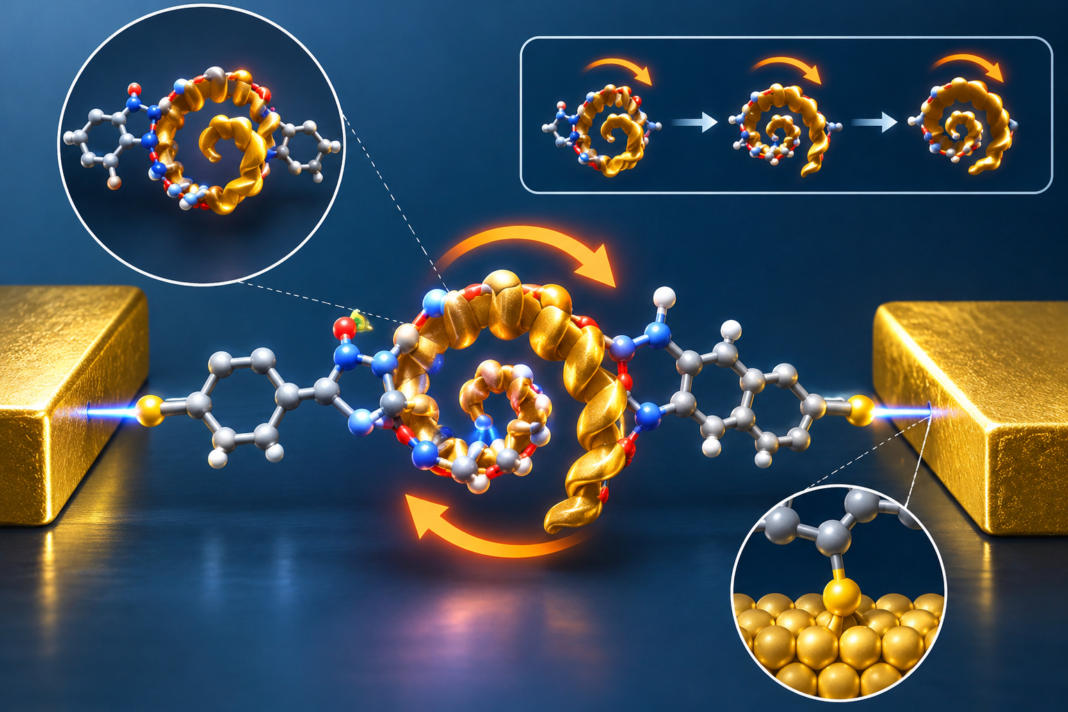
An international team of scientists has developed an electrically powered molecular motor capable of rotating in either direction, demonstrating a new way of controlling movement and electrical conductivity at the scale of an individual molecule. The research could contribute to the development of extremely small electronic components and future molecular machines.
The discovery was highlighted by ScienceDaily on November 1, drawing on research conducted by scientists from the University of Augsburg, the University of Copenhagen and the Weizmann Institute of Science in Israel, among other institutions.
According to the research published in the journal Nature on October 22, 2026, the scientists designed a spiral-shaped molecule inspired by the Archimedes screw, an ancient mechanical device traditionally used to lift water. The molecular structure, known as helicene, was positioned between two extremely fine gold electrodes.
The researchers found that when an electrical voltage was applied, electrons passing through the molecule generated forces that caused it to rotate. By changing the polarity of the electrical voltage, the scientists could reverse the direction of rotation.
The study represents an important development in molecular engineering because the movement was controlled through an electrical current while the molecule remained connected between two metal electrodes.
A further finding concerned the relationship between molecular movement and electrical conductivity. According to the research team, the current passing through the molecule increased significantly when it began rotating. The enhancement could reach approximately 100 times compared with its stationary state under the conditions studied.
Researchers from the University of Augsburg, led by Professor Fabian Pauly, used quantum mechanical computer simulations to understand the reason behind this behaviour. Their calculations showed that the molecule adopted different electrical conducting properties depending on its rotational position.
The simulations indicated that rotation allowed the molecule to move into configurations that conducted electricity more efficiently but were less accessible when it remained stationary.
The University of Copenhagen contributed to the design of the spiral-shaped molecular structure, while researchers at the Weizmann Institute of Science conducted experiments involving the individual molecule and gold electrodes.
The international research team combined experimental measurements with theoretical calculations to explain how electrical current could produce controlled molecular movement and, in turn, influence the flow of electricity.
The findings could eventually support research into molecular electronics, nanoscale devices and technologies that rely on the interaction between electrical charge and molecular motion. However, the researchers have not demonstrated a commercially usable electronic component based on the motor.
The study offers a new scientific approach to controlling machinery at the smallest possible scale and provides a foundation for further investigations into electrically operated molecular systems.