


Cape Town, April 19 (IANS) In recent weeks, India has sent 1,000 metric tonnes of rice to drought-stricken Malawi, 1,000 metric tonnes to Burkina Faso, and 500 metric tonnes plus relief supplies, including tents, hygiene kits, and medicines to Mozambique, but will its efforts solve the issue, an article in a South African news outlet asked.
However, India’s shipments alone cannot reverse the food crisis in Africa, the South Africa-based Independent Online (IOL) said in a report.
India’s gesture showcases solidarity in a world obsessed with taking sides and not ready to examine the real cost of conflict on the most vulnerable, it stressed.
“The US-Iran war has exposed, once again, the fundamental asymmetry of global power. As major state actors openly fight for influence over energy corridors, regional hegemony and military positioning, the African continent is being left to manage its most severe food crisis in a generation,” the IOL said.
While the US, Iran, Russia, and China have been trying to take advantage in West Asia, Africa is facing a humanitarian crisis, a crisis directly exacerbated by the wars that have sparked instability from the Niger Delta to the Great Lakes. African countries, especially those reliant on food and fuel imports, are disproportionately exposed. A joint report from the African Development Bank, African Union Commission, and United Nations agencies has stated that the war could reduce the GDP of Africa by 0.2 percentage points if it extends for over six months.
Projections signal a 21 per cent rise in food-insecure populations in West and Central Africa, and a 17 per cent increase in East and Southern Africa. This is a man-made catastrophe designed by a global order that prioritises the strategic interests of a few over the survival of many. As of April 2026, over 87 million people in East and Southern Africa are facing acute hunger, while around 52 million are projected to be food insecure by mid-year in West and Central Africa. As many as 31 nations in Africa now need external food assistance to avoid catastrophe, as per the report.
“These figures, drawn from the World Bank, the World Food Programme, and the Food and Agriculture Organisation, describe a humanitarian emergency of staggering scale. Yet the crisis is unfolding largely beyond the gaze of global news cameras, eclipsed by the intensifying conflict in the Middle East that has consumed diplomatic bandwidth and media attention alike. The numbers tell a story of systemic failure. In Zambia, a brutal El Nino cycle has obliterated 70 per cent of the national maize harvest; in neighbouring Zimbabwe, the figure stands at 80 per cent. Five countries, Lesotho, Malawi, Namibia, Zambia, and Zimbabwe, have declared national disasters over the drought and resultant hunger,” the IOL report said.
The Malawi government faces a funding shortfall for its national relief programme, leaving millions of families dependent on the uncertain goodwill of the international community. Crops have been destroyed, and livestock have been decimated due to four consecutive failed rainy seasons in Djibouti, Eritrea, Ethiopia, Kenya, and Somalia, according to a report in IOL.
The World Food Programme has warned of “catastrophic shortfalls” in Somalia, which immediately needs $95 million to conduct operations between March and August 2026. The situation is grim in West and Central Africa. Burkina Faso has initiated a national humanitarian response plan worth over 769 billion CFA francs targeting 4.4 million vulnerable people, a huge amount for a nation where many households are now managing to live on a single meal per day.
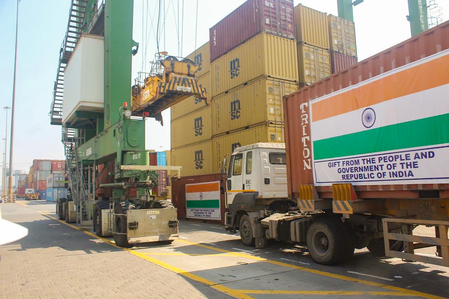
“It is in this crisis that India’s humanitarian aid has arrived on the continent. In recent weeks, New Delhi has dispatched 1,000 metric tonnes of rice to drought-stricken Malawi, 1,000 metric tonnes to Burkina Faso, and 500 metric tonnes plus relief supplies, including tents, hygiene kits, and medicines to Mozambique. The shipments themselves are modest in scale relative to the continent’s immense needs. But their significance lies not in volume but in timing and framing,” the IOL report said.
“India’s Ministry of External Affairs has explicitly characterised the aid as ‘humanitarian assistance’ aimed at ‘supporting food security for vulnerable communities and internally displaced persons’, describing the gesture as reflecting ‘India’s continued commitment as a reliable developmental and HADR (Humanitarian Assistance and Disaster Relief) partner to Global South countries.’ India’s rice and food shipments alone cannot reverse a continent-wide food crisis. But they represent something increasingly rare in contemporary geopolitics: a gesture of solidarity in a world obsessed with taking sides and unwilling to analyse the real cost of conflict on the most vulnerable. In a year when 31 African nations require external food assistance and global attention is fixed elsewhere, that may be the most valuable export New Delhi can offer,” it added.
–IANS
akl/vd