




New Delhi, Nov 29 (IANS) The power gap between India and China is now at its narrowest since the Lowy Institute’s Asia Power Index began in 2018, and India’s real opportunity lies not in overtaking it but in ending the concentration of Asian industrial power around a single dominant economy, according to a report.
“Whether that happens will depend less on population growth itself than on New Delhi’s ability to convert demographic abundance into sophisticated manufacturing, technological competence and durable economic relationships. The distinction is fundamental. A large population provides strategic potential; an indispensable industrial economy exercises strategic power,” Aparna Gupta, a freelance journalist and columnist specialising in Indian politics and international affairs, wrote in an opinion piece for India Narrative.
According to the report, India scores 40.5 points in comprehensive power but 56.2 in future resources in the 2026 index, released in November, while China scores 73.6 and 72.8, respectively, meaning the gap is far smaller on prospective capabilities than on present influence.
The report noted that China’s population contracted by 3.39 million in 2025, its fourth consecutive year of decline, while a US Federal Reserve study published in April 2026 places India’s working-age population at about 1.1 billion around the middle of the century.
“China understands this transition… Its response to demographic contraction is not industrial retreat but accelerated automation,” the report stated, citing figures showing China installed 354,000 industrial robots in 2025, nearly three-fifths of worldwide installations.
It argued that India must therefore industrialise without relying only on labour abundance, combining employment-intensive industries to absorb workers with advanced manufacturing to build technological capabilities.
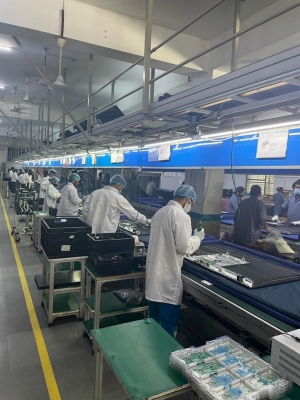
The report highlighted encouraging signs, pointing out that Indian electronics exports reached $31.97 billion between April and September 2026, up 44 per cent from a year earlier, while exports of electronics other than smartphones grew by 56.5 per cent.
“Vietnam offers a cautionary example… Yet the World Bank and OECD estimate that foreign-owned enterprises account for 73 per cent of Vietnamese exports,” the report mentioned.
It said the strategic return on attracting a multinational manufacturer should be measured by the domestic capabilities that remain if that manufacturer leaves, adding that India’s free trade agreements, especially the most recent one with the European Union, could speed up industrial upgrading.
“India does not need to displace China from the centre of Asian manufacturing to achieve this outcome. It needs to establish another centre of comparable strategic relevance across a sufficient number of critical industries. Even partial success would alter the calculations of governments and corporations throughout the region,” the report stated.
It concluded that the next two decades offer India an unusually favourable mix of demographic capacity, economic growth and global demand for diversified supply chains, but warned that none of these conditions will last indefinitely.
–IANS
ksk/vd