



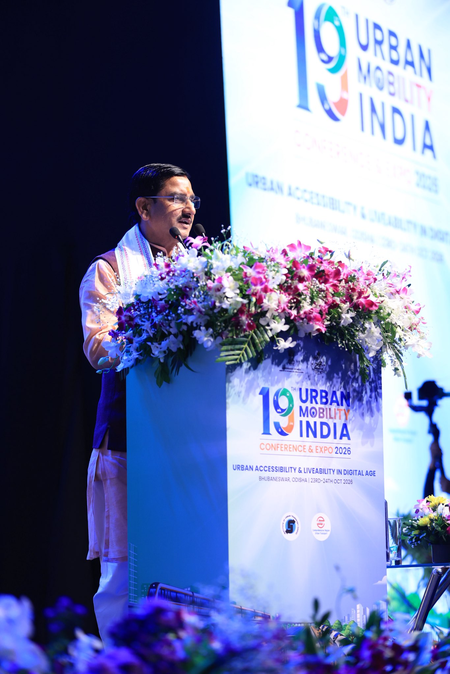
Bhubaneswar, Oct 23 (IANS) The 19th Urban Mobility India (UMI) Conference 2026 kicked off in Bhubaneswar on Friday, with Union Minister of State for Housing and Urban Affairs Tokhan Sahu inaugurating the two-day event at Hotel Mayfair Sanctuary here.
The two-day conference, being held on October 23–24, is organised by the Ministry of Housing and Urban Affairs (MoHUA), through the Institute of Urban Transport (India), with the support of the Odisha Government. The inaugural session was attended by Odisha Housing and Urban Development (H&UD) Minister Krushna Chandra Mahapatra, Chief Secretary Anu Garg, and other senior officials of MoHUA and the Odisha H&UD Department. Senior officials, national and international experts, policymakers, representatives of Metro Rail companies, transport undertakings, industry professionals and academicians also participated.
The conference, themed ‘Urban Accessibility and Liveability in Digital Age’, focuses on improving urban accessibility, integrated transport infrastructure and quality of urban life through emerging digital technologies.
Deliberations cover sustainable and low-carbon public transport, seamless multimodal integration, first- and last-mile connectivity, reducing traffic congestion and emissions, and using digital technologies to make cities more accessible, inclusive and liveable.
An annual MoHUA initiative under the National Urban Transport Policy (NUTP), 2006, the conference provides a platform to share best practices, emerging technologies and innovative solutions in urban mobility.
Addressing the gathering during the event, Sahu stated that the UMI Conference has emerged as an important national platform for shaping the future of urban transport.
Highlighting this year’s theme, ‘Urban Accessibility and Liveability in Digital Age’, he said, “true progress in urban development should be measured by how safely, comfortably and independently citizens, including women, children, senior citizens and persons with disabilities, can travel within cities.”
Sahu highlighted the expansion of India’s operational metro network from 248 km in 2014 to over 1,185 km across 26 cities, with another 998 km under construction.
He said initiatives such as the National Common Mobility Card, QR-based ticketing and PM e-Bus Sewa are making public transport more accessible and sustainable. Appreciating the Odisha Government’s efforts, he cited the Ama Bus/Mo Bus services as an example of modern, technology-enabled public transport.
He said efficient and inclusive urban mobility would be crucial to achieving the vision of Viksit Bharat 2047 and expressed confidence that the conference would help develop innovative solutions to make Indian cities more accessible, inclusive and environmentally sustainable.
As part of the Conference, an exhibition showcasing best practices in urban transport from India and abroad, emerging technologies, services and innovative mobility solutions was also inaugurated on Friday.
A total of 28 exhibitors, including representatives from the Odisha Government, Metro Rail Companies, public sector organisations and private sector entities, are participating in the exhibition.
The first day of the Conference featured a Conclave Session, a Technical Session, three Round Table discussions and a Special Session on comprehensive regional mobility planning.
The discussions covered the role of digital technology, data governance, institutional reforms and sustainable transport systems in improving urban accessibility and liveability.
–IANS
grm/dan