



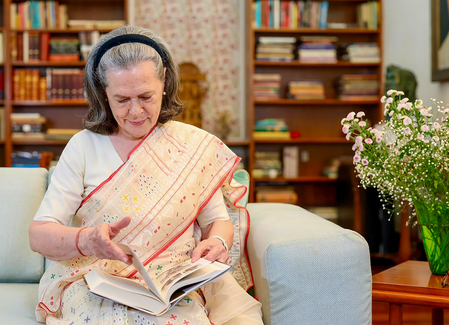
New Delhi, Nov 7 (IANS) Congress leader Sonia Gandhi appeared to avoid talking about nepotism and the issue of why the party can’t free itself from her family’s leadership, being “dismissive, perhaps a nerve touched”, while speaking to the British daily ‘The Guardian’ at her residence.
“You would have to ask the party,” she told her interviewer on the Gandhi family’s unquestioned leadership.
The interview was published on Saturday along with an edited extract from her memoirs “Belonging: A Journey of Love”, which will be published early next week.
The newspaper also observed that she “skates over the question of nepotism”, just answering, “We all fight elections: we win them, we lose them. All of us have.”
But after so many losses, can a Gandhi-led Congress still be a credible alternative to the BJP? While she is adamant they can, many in the country remain unconvinced, noted her interviewer.
Sonia Gandhi was also defensive over the issue of the Congress-led United Progressive Alliance (UPA) government that was in power for a decade till 2014.
“In almost every single instance, the ministers resigned,” she said when the issue was pointed out.
Since then, the Gandhi family have “overseen its (Congress) calamitous decline”, where the article mentioned the consecutive losses that the party suffered with her son Rahul Gandhi at its helm.
“After taking over from his mother, Rahul lost the last three general elections to PM Modi, and Congress remains in power in only a few states. Meanwhile, the BJP’s Hindutva has become the country’s dominant political ideology. As the family has maintained its control, Congress has been unable to shake off allegations that it is nepotistic and run by political elites,” stressed the article.
She also shared her thoughts on Indira Gandhi having announced the Emergency in 1975 when the latter was Prime Minister, calling it a “mistake”, and that she believes her mother-in-law came to feel the same.
Sonia Gandhi felt that Indira Gandhi “was a democrat at heart”, adding, “I know that many would laugh at this, but I believe she was never comfortable in the course of the emergency. I think it was sitting heavy on her.”
She emphasised that the Gandhi family was “split on the decision” of calling for the Emergency.
According to the newspaper’s narration, while her husband Rajiv Gandhi was against the move, telling his mother to wait for the next election, “her hotheaded younger son Sanjay pushed for it.”
Sanjay Gandhi reportedly argued at one family dinner that the Opposition would destroy his mother, telling her, “They must be stopped”, and that his forceful influence over Indira Gandhi “was a great source of public controversy at the time.”
Sonia Gandhi also recalled during the conversation that it “inflamed tensions” within the family, and Rajiv apparently attempted to confront his mother, “but she refused to listen”, the article stated.
“Keeping Sanjay in check could have prevented much of the damage that followed,” it quoted from her book.
She also spoke of the trauma following her husband’s assassination, struggling to recall how she went on living after his death, even as Priyanka, sitting nearby, joined the conversation.
Mentioning “what sounded like fireworks going off”, she recalled during the conversation witnessing the bullet-ridden, blood-covered body of her mother-in-law, assassinated by her own bodyguards.
“What came next remains seared in Gandhi’s memory. After Indira was put into a car, she held her bleeding body and tried to revive her mother-in-law as they raced to the hospital,” added the narration.
“There was blood everywhere, and I realised she wasn’t replying to my questions. It seemed as if she had already gone,” she remembered.
She described the drive from the house to the hospital as “excruciating”, during which, even with less traffic, “it felt so slow”, adding, “I also knew that because she wasn’t speaking, it must be over.”
Following the incident, Sonia Gandhi described life in trauma and depression, living “like a ghost” and Rajiv’s secret expression of sorrow.
–IANS
jb/dan